Author: m5jmm

  • You Didn’t Just Become This Way — But You Don’t Have to Stay This Way

    You Didn’t Just Become This Way — But You Don’t Have to Stay This Way

    Blog

    Your attitude was shaped by people, experiences, environments, and repeated messages. But once you understand what shaped you, you can begin to shape yourself.

    You Didn’t Just Become This Way

    But You Don’t Have to Stay This Way

    You did not become who you are by accident.

    The way you think, react, dream, work, hesitate, believe, and see yourself was shaped over time. By people. By experiences. By words. By praise. By criticism. By disappointment. By your environment.

    Long before you consciously asked yourself who you wanted to become, life had already started forming an image inside you.

    Before you shape yourself, you are shaped by others.

    And for many people, that shaping starts earlier than they realize.

    As a child, you do not naturally think in limitations. When a child says, “I want to be an astronaut,” “I want to be rich,” “I want to build something big,” or “I want to become famous,” the child does not immediately think about all the reasons why it might not work.

    To the child, it is possible.

    Not because the child already has the full plan. Not because the child understands every obstacle. But because the child has not yet learned to shrink himself down.

    A child sees possibility first.

    Adults often see limitation first.

    And many adults do not limit children because they are cruel. Often, they do it because they want to protect them. They do not want them to be disappointed. They do not want them to fail. They do not want them to suffer later because they expected too much from life.

    So they say things like:

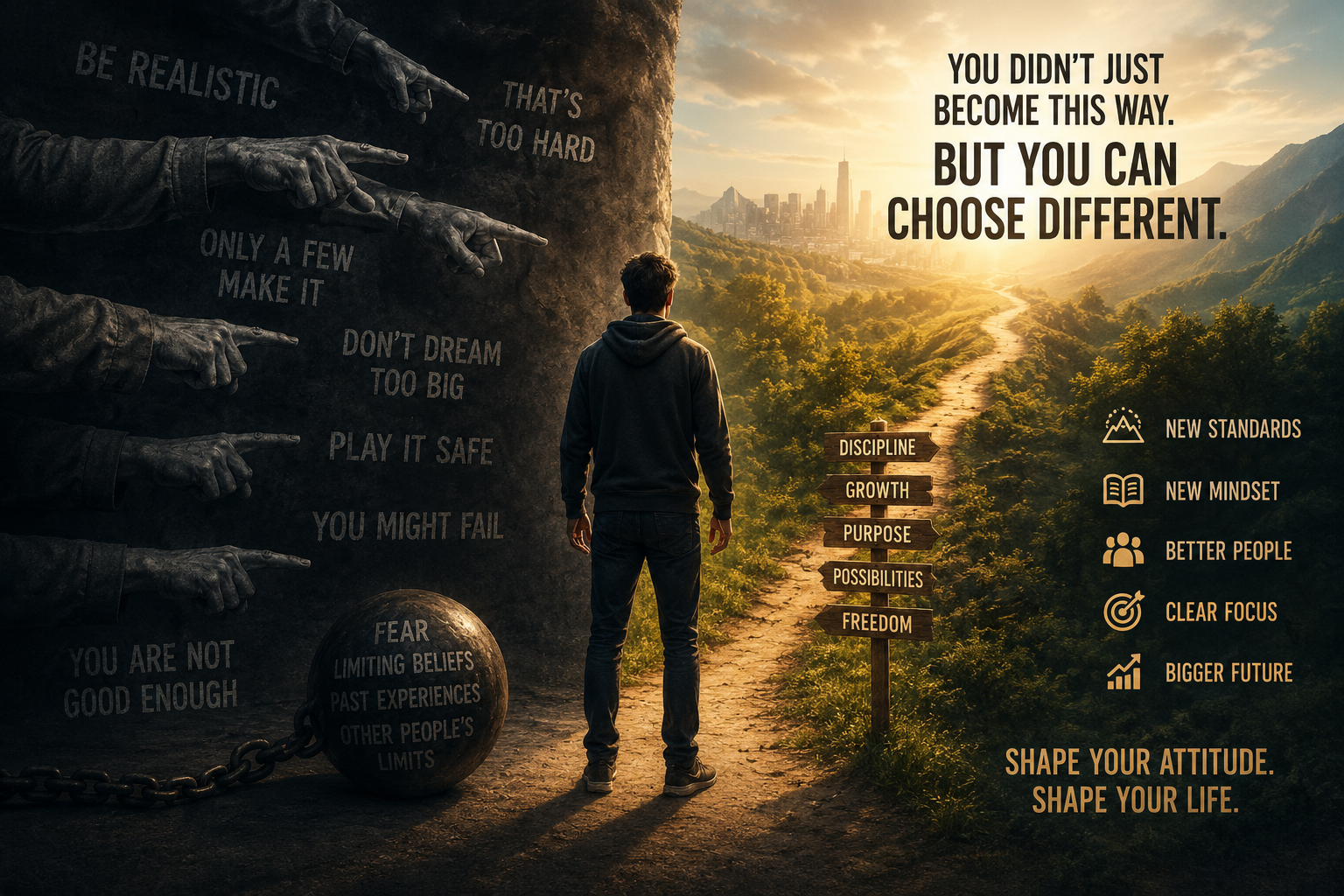
    “Be realistic.”
    “That’s hard.”
    “Only a few people make it.”
    “Choose something safe.”
    “Don’t dream too big.”

    Most of the time, there is no bad intention behind it. There may even be love behind it. Concern. Experience. A protective instinct.

    But this is where the problem begins.

    Many adults do not only pass on wisdom. They also pass on their own limits.

    They pass on what did not work for them.
    They pass on what they fear.
    They pass on what someone once talked them out of.
    They pass on beliefs they never questioned themselves.

    And suddenly, protection becomes limitation.

    Experience becomes a cage.

    Love becomes a quiet sentence in a child’s mind that still has power years later:

    “Maybe I shouldn’t think too big.”

    Not Every Warning Was Truth

    One of the most important realizations in personal growth is this:

    Not every warning you heard was truth.
    Sometimes it was only another person’s fear.

    That does not mean your parents were bad. It does not mean every teacher was wrong. It does not mean every piece of advice should be rejected.

    But it does mean you have to understand how early your attitude was shaped.

    A child does not come into this world thinking, “I am not good enough.”

    A child does not come into this world thinking, “I am not allowed to fail.”

    A child does not come into this world thinking, “I have to make myself small so I can be accepted.”

    Those beliefs are created.

    Through repetition.
    Through reactions.
    Through comparisons.
    Through looks.
    Through moments where a child feels, “Maybe I am too loud, too different, too slow, too dreamy, too much.”

    And then the child adapts.

    Not because he consciously decides, “I will become less myself now.”

    But because he learns:

    “If I adapt, I meet less resistance.”

    Later, we often call that personality.

    But sometimes it is not personality.

    Sometimes it is only an old protection pattern.

    Much of what you now call your personality may once have been nothing more than your way of adapting.

    Your Environment Shapes Your Standards

    This does not stop in childhood.

    It continues in school.
    In friendships.
    In work.
    In teams.
    In companies.
    Through colleagues.
    Through leaders.
    Through the people you spend time with every day.

    You do not only learn information from your environment.

    You adopt its pace.
    You adopt its standards.
    You adopt its excuses.
    You adopt its energy.
    You adopt its way of thinking.

    If you spend enough time in an environment where little is demanded, little can start to feel normal.

    If you spend enough time around people who always complain, complaining starts to feel normal.

    If you spend enough time around people who laugh at big goals, you eventually become more careful with your own dreams.

    If you spend enough time around people who accept excuses, excuses start to feel acceptable.

    And then, after a while, you may begin to believe:

    “This is just who I am.”

    But often, that is not true.

    Often, you have simply spent too much time in an environment that made your weaker version feel normal.

    Sometimes You Need a New Standard to Discover a New Self

    Many people say:

    “I’m just not disciplined.”
    “I’m just not ambitious.”
    “I’m just not resilient.”
    “I’m not the type of person who thinks big.”
    “I’m someone who gives up quickly.”

    But what if that is not your identity?

    What if that is only the result of the standards you have been surrounded by?

    Sometimes a new environment shows you a version of yourself you did not even know was there.

    When you enter an environment where more is expected, more is worked for, more responsibility is taken, and stronger standards are normal, something inside you can wake up.

    Not because that strength was not there before.

    But because it was not demanded before.

    You often only discover what you are truly capable of when you are placed under different standards.

    That does not mean you should destroy yourself. Growth is not about burnout. Strength is not about working yourself into the ground.

    But it does mean this:

    Your environment matters more than you think.

    The people around you are not neutral.
    The content you consume is not neutral.
    The conversations you repeat are not neutral.
    The standards you accept are not neutral.

    They are shaping you.

    Every day.

    The only question is: in which direction?

    You Are Allowed to Choose Who Shapes You Now

    At the beginning of your life, you cannot choose much.

    You are born into a family.
    Into a certain environment.
    Into a certain system.
    Into certain experiences.
    Into certain voices.

    You adopt beliefs, language, habits, values, fears, expectations, and inner images long before you fully understand what is happening.

    But at some point, responsibility begins.

    Not responsibility for everything that happened to you.

    But responsibility for what you do with it now.

    You can decide which voices you keep in your head.

    You can decide which books you read.
    Which audios you listen to.
    Which conversations you have.
    Which people you take seriously.
    Which role models you follow.
    Which standards you adopt.
    Which environments you seek.

    You cannot control everything.

    But you can consciously direct far more than many people believe.

    You are allowed to choose who shapes you from this point forward.

    That is one of the most powerful shifts in personal development.

    Because your attitude continues to be shaped every day.

    By old fears or new clarity.
    By people who keep you small or people who pull you forward.
    By excuses or responsibility.
    By limitation or growth.
    By unconscious repetition or conscious decision.

    You did not just become this way.

    But you do not have to stay this way either.

    Build a New Inner Voice

    Maybe nobody told you often enough that you were capable.

    Maybe your dreams were laughed at.

    Maybe you were criticized more than you were encouraged.

    Maybe you learned to adapt instead of unfold.

    Maybe you learned to stay quiet, stay small, stay realistic, stay safe.

    But that does not mean the old voice has to remain the strongest voice inside you.

    You can begin today to build a new inner voice.

    One that says:

    “I can grow.”
    “I can learn.”
    “I can get better.”
    “I am allowed to think bigger.”
    “I am not bound to other people’s limitations.”
    “I do not have to build my future on someone else’s fear.”
    “I am allowed to become more than what my past taught me to expect.”

    A strong self-image does not protect you from every setback.

    But it changes how you interpret setbacks.

    And that changes everything.

    Because the same failure can either confirm your old limitation or train your new strength.

    The same criticism can either make you shrink or make you clearer.

    The same challenge can either prove that you are not enough or show you that you are capable of growing.

    Your attitude decides what meaning you give to what happens.

    And the meaning you give to what happens shapes who you become next.

    The Moment You See It, You Can Change It

    You are not here to condemn everyone who shaped you.

    Many people only passed on what they knew.
    Many acted from their own fear.
    Many may even have wanted to protect you.

    But protection is not always growth.

    And experience is not always truth.

    Sometimes experience is only proof of what someone else did not achieve, did not understand, or never dared to try.

    That is why you have to learn to ask better questions:

    What truly belongs to me?
    What did I only adopt?
    What attitude was modeled for me?
    What standards did I accept?
    What limits did I believe, even though I never tested them myself?
    Who do I consciously want to become now?

    That is where the shift begins.

    As long as you live unconsciously, you are guided by old conditioning.

    But the moment you begin to look consciously, freedom of choice appears.

    You cannot change your past.

    You cannot go back and hear different words.
    You cannot undo every experience.
    You cannot erase every sentence that shaped you.

    But you can begin today to reshape yourself.

    Through new thoughts.
    Through new decisions.
    Through new standards.
    Through new people.
    Through new books.
    Through new environments.
    Through new actions.

    Not all at once.

    Not perfectly.

    Not without resistance.

    But consciously.

    Because the moment you realize you were shaped is the moment you can begin to shape yourself.

    And if your attitude does not change, nothing changes.


    Closing CTA

    If this message speaks to you, my book Shape Your Attitude goes deeper into this exact process: how old patterns are formed, how your inner posture is shaped, and how you can begin to consciously become the person you were meant to be.

    This section provides an overview of the blog, showcasing a variety of articles, insights, and resources to inform and inspire readers.

  • Your Attitude Is Shaped by the Decisions You Repeat

    Your Attitude Is Shaped by the Decisions You Repeat

    your-attitude-is-shaped-by-decisions

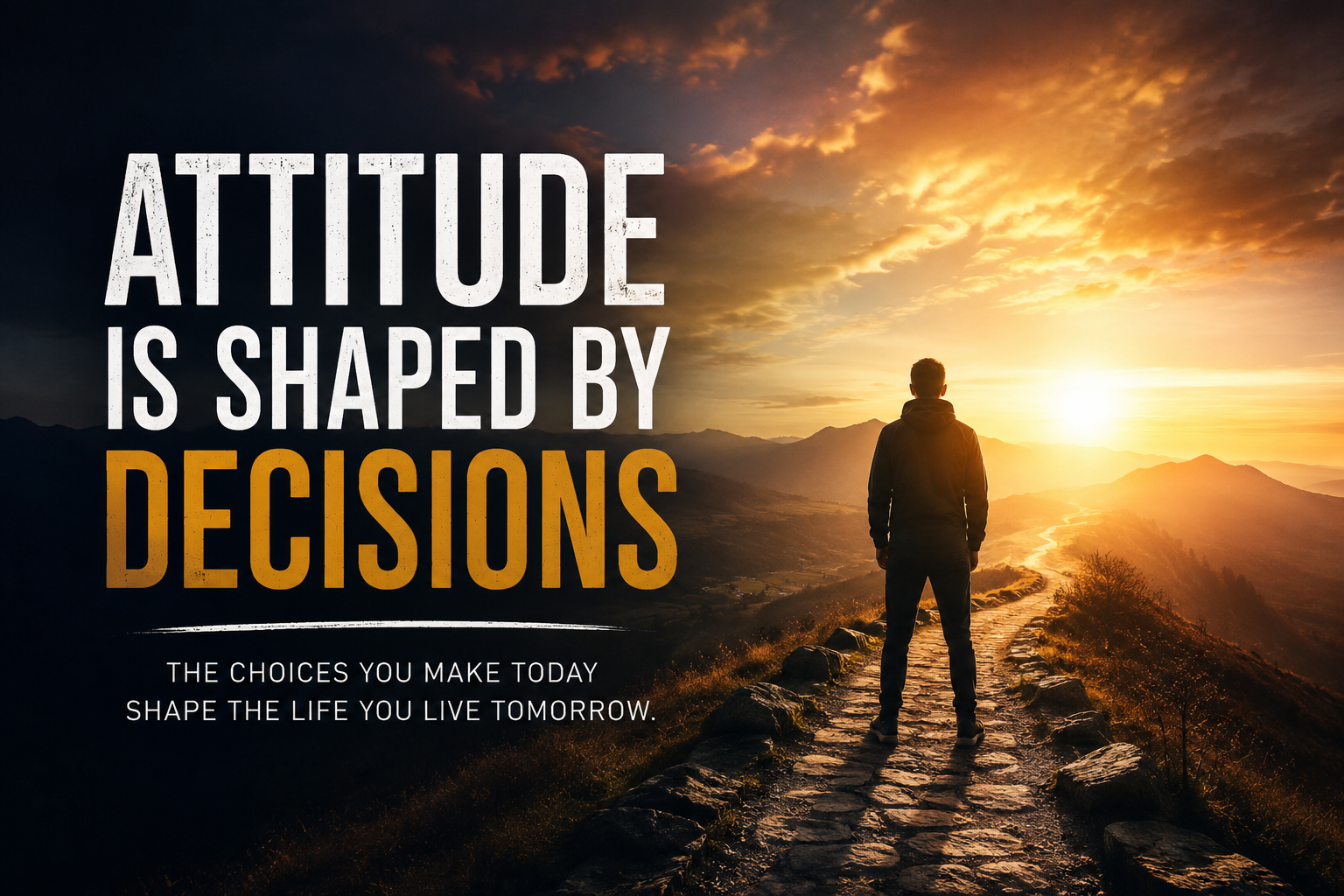
    Your attitude is not fixed. It is shaped by the thoughts, reactions, meanings, and decisions you repeat every day.

    Your Attitude Is Shaped by the Decisions You Repeat

    Attitude does not change in one powerful moment.

    Not through one motivational quote.
    Not through one perfect morning.
    Not through one good conversation.
    Not through one short burst of inspiration.

    Your attitude changes through what you choose again and again.

    It is shaped by how you think when life becomes difficult.
    How you react when something does not work.
    How you speak to yourself after a mistake.
    How you get back up when you do not feel like it.
    How you keep going when nobody sees you.

    That is where your real attitude shows.

    Not when everything is easy.
    Not when everything works.
    Not when people applaud you.

    Your attitude becomes visible when life challenges you and you still have to decide who you are.

    Because attitude is not formed in the easy moments.
    It is formed in the uncomfortable ones.

    Attitude Is Not Fixed

    Many people believe attitude is something you either have or do not have.

    You are either positive or negative.
    Strong or weak.
    Disciplined or undisciplined.
    Brave or afraid.

    But attitude is not a fixed label.

    Attitude is a pattern.

    It is made of thoughts, reactions, decisions, standards, and repeated inner choices. And because it is a pattern, it can be trained.

    Every time you take responsibility, you strengthen one attitude.
    Every time you make excuses, you strengthen another.

    Every time you keep going despite resistance, you build a stronger inner posture.
    Every time you talk yourself down, you strengthen the part of you that wants to give up.

    You are training your attitude every day.

    Either consciously.
    Or unconsciously.

    That can be uncomfortable to admit. But it is also freeing.

    Because if your attitude has been trained, it can be reshaped.

    You are not helpless against old reactions.
    You are not trapped by past patterns.
    You are not limited to the version of yourself you have been until now.

    Just because you gave up quickly in the past does not mean you are a person who gives up.

    Just because you often thought negatively in the past does not mean you have to remain negative.

    Just because fear influenced your decisions before does not mean fear has to decide your future.

    Your past may explain your patterns.
    But it does not have to decide your direction.

    1. What Meaning Are You Giving the Situation?

    One of the most important decisions you make every day is this:

    What meaning do I give to what is happening right now?

    Because often, we do not react to the situation itself.
    We react to the story we create about it.

    Something happens.

    A message.
    A look.
    A mistake.
    A setback.
    A delay.
    A moment of uncertainty.

    And immediately, the mind begins to build a story.

    What if this gets worse?
    What if I fail?
    What if they think badly of me?
    What if I make the wrong decision?
    What if this turns into a bigger problem?

    Suddenly, you are no longer dealing with reality.

    You are dealing with a movie in your mind.

    A possibility.
    A projection.
    A fear that has not even happened yet.

    Not every fear shows you the truth.
    Some fears only show you a possible scenario.

    That is why you have to learn to examine your thoughts.

    Not every thought deserves your full attention.
    Not every worry is a warning.
    Not every inner image is a signal.

    Sometimes your mind is only trying to gain control over something uncertain.

    So pause and ask yourself:

    Is this really happening right now?
    Or am I imagining what could happen?

    Has this already happened?
    Or am I afraid that it might happen?

    Do I have facts?
    Or am I building a story?

    That one pause can change everything.

    Because reality and interpretation are not the same thing.

    Reality is what actually happened.
    Interpretation is what you are making it mean.

    Reality is the fact.
    Interpretation is the story.

    Reality asks, “What needs to be done now?”
    Fear asks, “What could possibly go wrong?”

    A strong attitude begins when you learn to separate the two.

    You do not have to give every situation more power than it deserves.

    If something is real, act.
    If something has happened, learn.
    If something is uncertain, stay clear.
    If something only exists in your mind, do not hand it your whole life.

    Because your attitude is not only shaped by what happens to you.

    It is shaped by the meaning you give to what happens to you.

    Sometimes you do not need to change the situation first.

    You need to change the meaning you have attached to it.

    2. Which Inner Voice Are You Feeding?

    There is an old story about two wolves.

    A grandmother tells her grandson that two wolves are fighting inside every person.

    One wolf represents fear, doubt, insecurity, anger, self-pity, and the voice that keeps you small.

    It says:

    You cannot do this.
    You are not ready.
    Others are better than you.
    You will fail.
    Why should you, of all people, be able to make it?

    This voice makes possibilities smaller and problems bigger.

    The other wolf represents courage, discipline, hope, trust, clarity, responsibility, and growth.

    It says:

    You can learn.
    You can grow.
    You do not have to start perfectly.
    You have already survived difficult things.
    Take the next step.
    Stay with it.

    At the end of the story, the grandson asks:

    “Which wolf wins?”

    The grandmother answers:

    “The one you feed.”

    And that is exactly how attitude works.

    Your attitude is shaped by the voice you feed inside yourself.

    Not every voice inside you deserves to lead you.

    Some voices come from old experiences.
    Some come from fear.
    Some come from wounds.
    Some come from people who once made you believe you were not enough.

    But just because a voice speaks inside you does not mean it is right.

    Just because a thought is loud does not mean it is true.

    Just because doubt appears does not mean doubt has to make your decision.

    Every time you blindly believe your doubt, you feed it.

    Every time you talk yourself down, you feed it.

    Every time you say, “I cannot do this anyway,” you feed the part of you that keeps you weak.

    But every time you answer differently, you feed another side.

    When you say:

    I can learn this.
    I do not have to do it perfectly.
    I am allowed to get better.
    I have already done hard things.
    I will take one more step.

    You feed the part of you that makes you stronger.

    And over time, that part grows.

    Not immediately.
    Not through one sentence.
    But through repetition.

    The voice you feed every day eventually becomes the attitude you live from.

    That does not mean you will never feel fear again.

    It does not mean you will never doubt yourself again.

    It does not mean you will wake up every morning full of confidence.

    It means you stop making the weakest thought inside you your leader.

    You can feel fear and still choose differently.

    You can hear doubt and still keep going.

    You can feel uncertainty and still take responsibility.

    That is attitude.

    Not the absence of fear.
    But the conscious decision not to feed fear.

    3. Who Do You Want to Be in This Moment?

    One of the strongest questions you can ask yourself is:

    Who do I want to be in this moment?

    Not someday.

    Not in ten years.

    Not when life gets easier.
    Not when you have more money.
    Not when you feel more confident.
    Not when other people finally understand you.

    Now.

    In this moment.

    Because this is where change begins.

    Many people wait to become a different version of themselves someday.

    More disciplined.
    More focused.
    More confident.
    More responsible.
    More calm.
    More courageous.

    But that version does not suddenly appear.

    It is created through decisions.

    Through small moments.
    Through different reactions.
    Through new standards.
    Through choosing your future instead of repeating your past.

    You become a different version of yourself by repeating different decisions today.

    So ask yourself:

    How do I want to think?
    How do I want to respond?
    How do I want to deal with pressure?
    How do I want to handle criticism?
    How do I want to lead myself?
    How do I want to live?

    Because when you have no clear inner direction, your old state often decides for you.

    Your habit decides.
    Your fear decides.
    Your comfort decides.
    Your wounded ego decides.
    Your past decides.

    But when you know who you are becoming, you get orientation.

    Then you stop asking only:

    “How do I feel right now?”

    And you begin to ask:

    Which decision fits the person I want to become?

    That question changes your direction.

    Attitude Is Built in the Everyday Moments

    A strong attitude is not created by never feeling weak.

    It is created when you stop letting every weak moment lead you.

    You do not need a perfect attitude.

    You need an attitude that keeps standing back up.

    You need the ability to pause.
    To question your thoughts.
    To choose the meaning you give a situation.
    To feed the stronger voice.
    To act from the person you want to become, not only from the person you have been.

    That is how attitude is shaped.

    Not in theory.

    Not in motivation.

    Not in beautiful words.

    But in daily practice.

    In the moment you want to quit, but take one more step.
    In the moment fear gets loud, but you do not feed it.
    In the moment your old pattern appears, but you choose your new standard.

    Because in the end, what you know about attitude is not what matters most.

    What matters is the attitude you live when life challenges you.

    And that attitude is built decision by decision.

    Thought by thought.

    Reaction by reaction.

    Day by day.

    Final Thought

    Your attitude is not fixed.

    It is being shaped every day by what you choose, what you repeat, what you feed, and what you allow to lead you.

    So do not wait for the perfect moment to become stronger.

    Start with the next decision.

    Because the person you are becoming is not created someday.

    That person is created in the decision you make now.

    If your attitude changes, your direction changes.
    And when your direction changes, your life begins to change with it.

    This section provides an overview of the blog, showcasing a variety of articles, insights, and resources to inform and inspire readers.

  • Why Attitude Directs Your Life

    Why Attitude Directs Your Life

    Blog

    Why Attitude Directs Your Life

    Your attitude is not just how you feel. It is the filter that decides what you see, what you believe is possible, and how you respond to life.

    Most people think their life is shaped by their decisions.

    And of course, decisions matter.

    But before you make a decision, something deeper is already working in the background: your attitude.

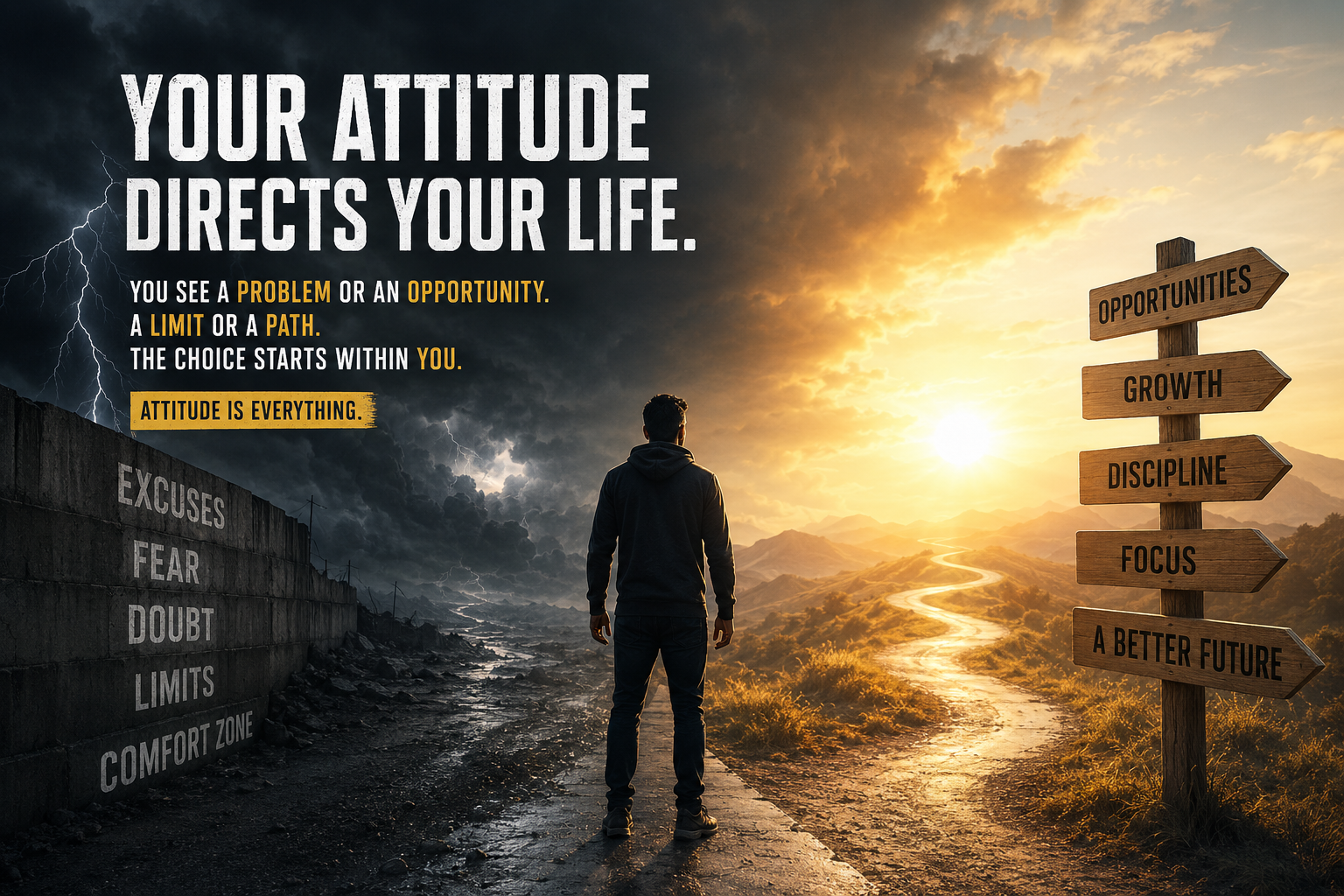
    Your attitude decides how you see a situation before you even fully think about it. It decides whether you see a problem or an opportunity. Whether you feel attacked or challenged. Whether you see a limit or a path. Whether your first thought is, “Why is this happening to me?” or “What can I do with this now?”

    That is why attitude directs your life.

    Not loudly.
    Not always visibly.
    Not always consciously.

    But constantly.

    Because your thoughts come from your attitude. Your decisions come from your thoughts. Your actions come from your decisions. And your life comes from your actions.

    If the foundation is wrong, everything after it becomes harder.

    Your Attitude Is the Filter

    The problem is not always the situation.

    Often, the problem is the way you see the situation.

    Two people can face the same setback and react completely differently.

    One person sees rejection and thinks, “This proves I am not good enough.”
    Another person sees rejection and thinks, “This feedback can make me better.”

    One person sees difficulty and thinks, “This is the end.”
    Another person sees difficulty and thinks, “This is hard, but what is still possible?”

    Same situation.
    Different attitude.
    Different direction.

    That is not a small difference.

    It is the difference between standing still and moving forward. Between excuses and responsibility. Between retreat and new action.

    Your attitude does not only decide how you feel. It decides which path you even believe is possible.

    The Situation Does Not Decide Everything

    Life will bring problems. That is not the question.

    The question is: What do you see inside the problem?

    Some people experience a setback and immediately use it as proof that their goal is impossible.

    They try something once. It does not work immediately. And then they say:

    “See? I knew it. This doesn’t work.”

    But maybe that is not true.

    Maybe it does work. Just not like this.

    Maybe the idea was not wrong. Maybe the execution was wrong. Maybe the goal was not wrong. Maybe the strategy was not clear enough. Maybe the path was not impossible. Maybe you simply stopped too early.

    That is where attitude becomes decisive.

    A weak attitude looks for confirmation that something cannot work.
    A strong attitude looks for the next useful step.

    This applies to business. To discipline. To relationships. To personal growth. To health. To leadership. To everything that requires change.

    The situation does not automatically decide your path.

    Your attitude decides which path you are even able to recognize inside that situation.

    Your First Reaction Reveals Your Real Attitude

    It is easy to say the right things when everything is calm.

    It is easy to talk about discipline when you are motivated.
    It is easy to talk about responsibility when life is going well.
    It is easy to talk about strength when nothing is testing you.

    But your real attitude shows in your first inner reaction.

    When something goes wrong.
    When someone criticizes you.
    When you are tired.
    When you are disappointed.
    When you compare yourself to someone else.
    When your plan does not work.
    When you receive a rejection.
    When life does not move the way you wanted.

    That first reaction matters.

    Because your first reaction is often not the truth.

    It is your trained pattern.

    If you have trained yourself to think negatively for years, your first thought will often be negative.

    If you have trained yourself to look for excuses, your first impulse will often be an excuse.

    If you have trained yourself to give away responsibility, your first reaction will often be to blame someone else.

    If you have trained yourself to feel small, your first response to bigger possibilities may be rejection.

    Not because those possibilities are impossible.

    But because your attitude does not yet allow them.

    And that is important.

    Because what has been trained can also be changed.

    You Do Not Need Positive Thinking. You Need Better Questions.

    Changing your attitude does not mean lying to yourself.

    It does not mean pretending that every situation is good.
    It does not mean ignoring pain.
    It does not mean forcing yourself to smile when something is wrong.

    That is not strength. That is denial.

    Real attitude change is different.

    It means asking better questions when your old pattern wants to take over.

    Instead of asking:

    “Why is this happening to me?”

    Ask:

    “What can I do with this now?”

    Instead of asking:

    “Why is everything working against me?”

    Ask:

    “What is in my responsibility right now?”

    Instead of asking:

    “Why is this so hard?”

    Ask:

    “What is the next useful step?”

    Instead of asking:

    “Why do others have more luck?”

    Ask:

    “What can I learn?”

    These questions do not magically change the situation.

    But they change your direction.

    And direction is decisive.

    Many people do not lose because a situation is difficult. They lose because their attitude leads them in the wrong direction.

    Into excuses.
    Into bitterness.
    Into envy.
    Into self-pity.
    Into stagnation.

    Not because there is no other possibility.

    But because inwardly, they do not see another possibility.

    That is exactly what must change.

    Attitude Changes in Small Moments

    Most people wait for the big moment.

    They think change happens after a huge breakthrough, a dramatic decision, or a powerful emotional experience.

    But attitude usually changes somewhere much smaller.

    It changes in everyday life.

    When you would normally get annoyed, but you pause.

    When you would normally make an excuse, but you ask yourself what part is your responsibility.

    When you would normally think negatively, but you consciously look for one useful next step.

    When you would normally give up, but you take one small action anyway.

    That is training.

    Not spectacular.
    But powerful.

    Because every moment in which you react differently than before weakens the old pattern and strengthens the new one.

    That is how attitude changes.

    Not through one big motivational moment.

    But through many small conscious decisions.

    Day by day.
    Situation by situation.
    Reaction by reaction.

    A Simple Exercise: The 10-Second Check

    Starting today, observe your first reaction.

    Not the reaction you explain later.
    Not the polished version you show on the outside.
    Not the response you create after thinking about it for five minutes.

    The first one.

    When something happens, give yourself ten seconds and ask:

    What was my first thought just now?

    Was it negative?
    Was it defensive?
    Was it full of excuses?
    Was it focused on blame?
    Was it small?

    Or was it calm?
    Solution-oriented?
    Clear?
    Forward-looking?

    That first reaction shows you where your attitude currently is.

    Do this three to five times today.

    Do not judge yourself. Just observe honestly.

    Awareness is the beginning of change.

    The Mirror Moment

    Once a day, ask yourself one uncomfortable but powerful question:

    Where did I give away responsibility today?

    Not with shame.
    Not with self-hate.
    Not to attack yourself.

    But honestly.

    Maybe not everything was your fault. That is true.

    But almost always, there is some part that belongs to you.

    Your reaction.
    Your preparation.
    Your communication.
    Your decision.
    Your discipline.
    Your next step.

    And that is the part you look for.

    Because that is where your power is.

    The moment you find your responsibility, you find your influence again.

    The Sentence That Brings You Back

    There is one sentence that can bring you back when your old attitude takes over:

    If my attitude does not change, nothing changes.

    Use it when you notice yourself falling into old patterns.

    When you are frustrated.
    When you want to give up.
    When you are looking for excuses.
    When you feel sorry for yourself.
    When you are blaming everything except your own next move.

    Not as motivation.

    As a reminder.

    The problem is not only the situation. The problem may also be the way you are looking at it.

    And you can change the way you look at it.

    Your Life Follows Your Direction

    Attitude is not something you understand once and then possess forever.

    Attitude is something you live.

    In thoughts.
    In reactions.
    In decisions.
    In small moments that may seem unimportant from the outside but shape everything inside.

    That is why attitude directs your life.

    Not once.
    Every day.

    Not only in big decisions.
    But in small repeated reactions.

    In the end, one simple truth remains:

    You will not change your life only by working harder.

    You will change your life by looking at your life differently.

    Because when you look differently, you think differently.
    When you think differently, you decide differently.
    When you decide differently, you act differently.
    And when you act differently, a different life begins.

    If your attitude does not change, nothing changes.


    CTA

    This article is based on the core message of my book ATTITUDE IS EVERYTHING.

    If you want to go deeper into how your mindset shapes your discipline, direction, and future, this book was written for you.

    Because real change does not start with perfect circumstances.

    It starts with the attitude you bring into them.

    This section provides an overview of the blog, showcasing a variety of articles, insights, and resources to inform and inspire readers.

  • Why Discipline Comes From Attitude – ATTITUDE IS EVERYTHING

    Why Discipline Comes From Attitude – ATTITUDE IS EVERYTHING

    Why Discipline Comes From Attitude

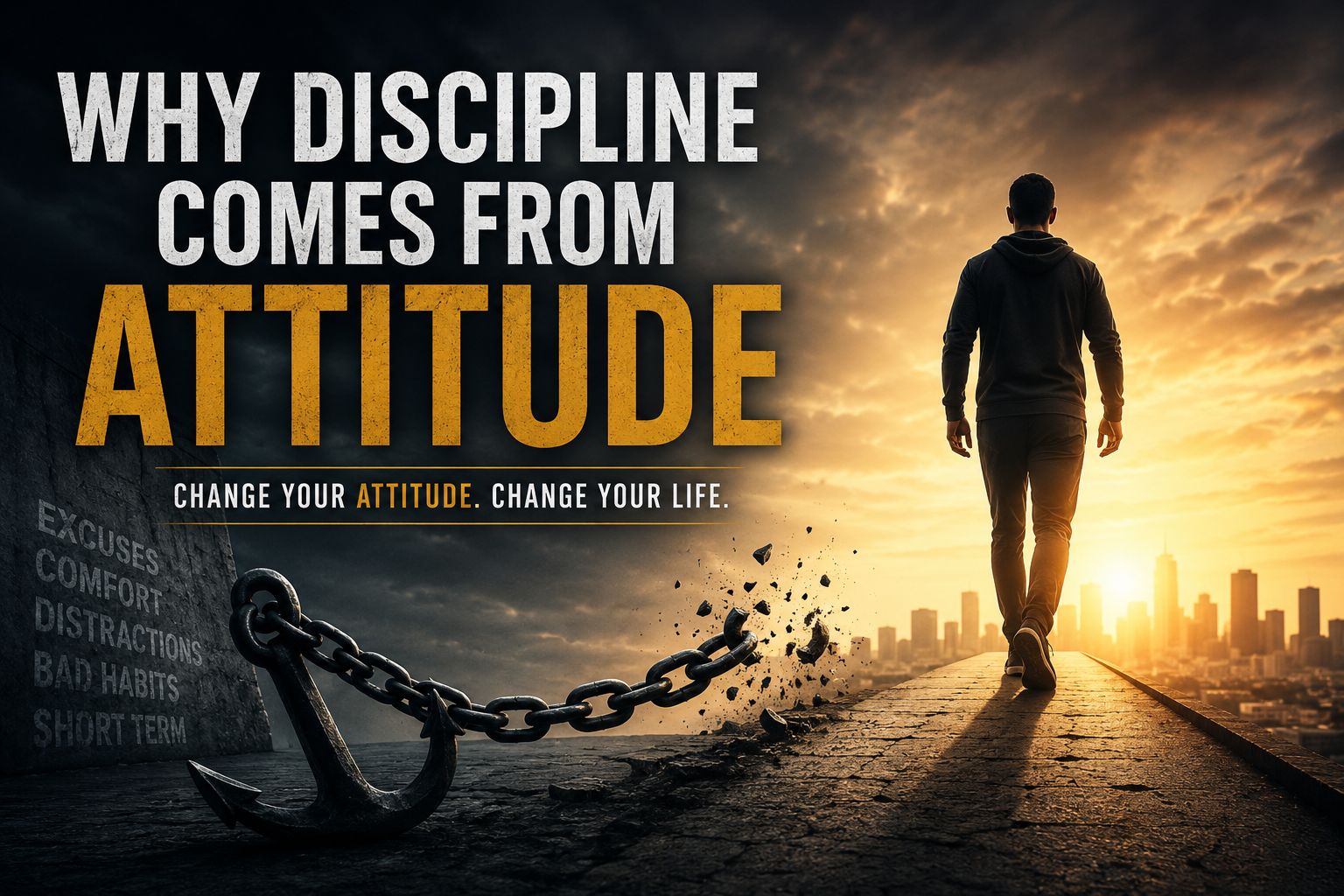
    Most people do not have a discipline problem.
    They have the wrong attitude toward discipline.

    This is one of the core ideas behind my book ATTITUDE IS EVERYTHING.

    Because real change does not begin with another routine, another plan, or another burst of motivation. It begins with the attitude you bring into your decisions every single day.

    Many people try to become more disciplined by forcing themselves harder. They push. They pressure themselves. They create new rules. They promise themselves that this time will be different.

    But deep inside, they still see discipline as restriction.

    As sacrifice.
    As pressure.
    As something that takes freedom away from them.

    And that is exactly why discipline feels so hard.

    Because nobody can stay committed long term to something that feels like punishment on the inside. You can force yourself for a few days. Maybe even for a few weeks. But eventually, if your attitude is working against your decision, you will fight against the very thing you said you wanted.

    That is why discipline does not begin with action.

    It begins with meaning.

    Before the alarm clock.
    Before the workout plan.
    Before the to-do list.
    Before the nutrition plan.
    Before the savings plan.

    There is one deeper question:

    What does discipline mean to you?

    Is discipline a prison?
    Or is it a tool?

    Is it something that limits you?
    Or something that frees you?

    Is it a loss?
    Or is it an investment?

    That is where everything changes.

    And that is exactly what ATTITUDE IS EVERYTHING is about:

    Not discipline as pressure.
    But discipline as direction.

    Not change through force.
    But change through a stronger inner attitude.

    Discipline Is Not the Enemy of Freedom

    Many people believe discipline takes freedom away.

    But in most cases, the opposite is true.

    Lack of discipline takes freedom away.

    Bad nutrition takes your energy.
    No exercise takes your strength.
    Poor money habits take your options.
    Aimless consumption takes your time.
    Procrastination takes your self-confidence.
    Excuses take your responsibility.

    Discipline gives these things back to you piece by piece.

    When you eat better, you are not simply giving up unhealthy food. You are building more energy, more clarity, and more control over your life.

    When you exercise regularly, you are not only spending time. You are building a stronger body, a stronger self-image, and more trust in yourself.

    When you save money, you are not only saying no to immediate consumption. You are creating space, security, and future options.

    When you stop filling every evening with distraction and start building something, you are not losing entertainment. You are investing in your skills, your knowledge, your business, your independence, and your future.

    That is the shift.

    From:

    Discipline takes something away from me.

    To:

    Discipline gives something back to me.

    This is the turning point.

    Discipline Moves Freedom Into the Future

    Discipline does not always feel comfortable in the moment.

    Sometimes it costs time.
    Sometimes it costs energy.
    Sometimes it means saying no.
    Sometimes it means doing the right thing when the easy thing would feel better.

    But the question is not only:

    What does this cost me now?

    The better question is:

    What will this give me later?

    Most people choose short-term freedom and pay for it with long-term dependency.

    They eat whatever they want now and pay with low energy later.
    They spend everything now and pay with financial pressure later.
    They avoid hard work now and pay with regret later.
    They delay their goals now and pay with lost confidence later.

    Discipline works differently.

    Discipline means choosing short-term structure so you can create long-term freedom.

    That is not mainly a question of talent.

    It is a question of attitude.

    Because when you see discipline as punishment, you will always resist it.

    But when you see discipline as an investment, you begin to respect it.

    And what you respect, you are much more likely to protect.

    Discipline Is Like Planting Seeds

    At first, discipline often looks like nothing is happening.

    You train, but your body does not look different immediately.
    You save money, but your account does not feel big yet.
    You build something, but nobody sees it.
    You learn, but nobody is clapping yet.
    You work, but the results have not arrived yet.

    This is the phase where many people quit.

    They believe nothing is happening.

    But that is not true.

    Something is growing under the surface.

    Roots are forming.
    Structure is forming.
    Identity is forming.
    Self-confidence is forming.

    Every good decision is a seed.

    Every workout.
    Every healthy meal.
    Every dollar you save.
    Every hour of focus.
    Every page you read.
    Every excuse you do not accept.
    Every task you complete even though you do not feel like it.

    All of these are seeds.

    And eventually, something grows from them.

    Not immediately.
    But more certainly than most people think.

    That is why you must change your attitude from:

    I am sacrificing.

    To:

    I am building.

    From:

    This is exhausting.

    To:

    This is my path.

    From:

    I am taking something away from myself.

    To:

    I am creating something for myself.

    From:

    I have to force myself.

    To:

    I am choosing my future.

    This is one of the most important shifts in ATTITUDE IS EVERYTHING.

    Because discipline is not only about doing more.

    It is about seeing differently.

    When your meaning changes, your behavior changes.

    And when your behavior changes, your life changes.

    Discipline Builds Trust With Yourself

    Discipline does not only change your results.

    It changes your self-image.

    Every time you follow through on something, you build trust with yourself.

    You prove to yourself:

    I do what I said I would do.

    And that matters more than most people understand.

    Because many people do not trust themselves anymore. Not because they are incapable. But because they have disappointed themselves too often.

    They said, “I will start.”
    Then they stopped.

    They said, “I will follow through.”
    Then they quit.

    They said, “Tomorrow.”
    Then tomorrow became another excuse.

    Over time, your word to yourself loses weight.

    You start believing yourself less.
    You take your own decisions less seriously.
    You expect less from yourself.

    And eventually, a weak self-image is created.

    But discipline can rebuild that.

    Not through big promises.

    Through small proof.

    You choose one thing.
    You follow through.
    You keep your word.

    And slowly, you begin to trust yourself again.

    That is powerful.

    Because when you trust yourself, your posture changes. You think bigger. You act more clearly. You enter challenges differently. You stop seeing yourself as someone who always starts and stops.

    You begin to see yourself as someone who can follow through.

    That is why discipline is not only behavior.

    Discipline is identity building.

    Discipline Is a Relationship With Yourself

    Every decision tells you something about yourself.

    If you constantly give in, you learn:

    I give in.

    If you constantly postpone, you learn:

    I do not keep my word.

    If you constantly accept excuses, you learn:

    My goals are not truly binding.

    But if you act even when it is uncomfortable, you learn:

    I can lead myself.

    If you follow through even when you do not feel like it, you learn:

    I am stronger than my mood.

    If you keep your word, you learn:

    I can trust myself.

    That is how self-respect is created.

    Not from motivation.
    Not from beautiful words.
    Not from what you show to the outside.

    But from the quiet knowledge:

    I do what is necessary, even when it is uncomfortable.

    That is real discipline.

    Not perfection.
    Not hardness.
    Not never failing.

    Discipline means you return.

    You will have bad days.
    You will make mistakes.
    You will feel tired.
    You will doubt yourself sometimes.

    But the difference is this:

    A weak attitude says:

    Now it does not matter anyway.

    A strong attitude says:

    I get back in.

    That is discipline.

    Not falling once and staying down.

    But getting up and continuing.

    Discipline Is Not Force. Discipline Is Leadership.

    Many people think discipline means becoming harder.

    But often, you do not need to become harder.

    You need to become clearer.

    Clearer about what you want.
    Clearer about why it matters.
    Clearer about what your current habits are costing you.
    Clearer about the future you are building.

    Because when you truly understand what discipline gives you, your relationship with it changes.

    Then discipline is no longer the enemy of your freedom.

    It becomes the path to your freedom.

    Discipline is not force.

    Discipline is a decision.

    A decision for your future self.
    For the person you want to become.
    For the life you want to build.
    For the freedom you want to have later.

    And that is why discipline comes from attitude.

    Because you only stay committed long term to what you value correctly on the inside.

    If you see discipline as a loss, you will always fight against it.

    But if you see discipline as an investment, you begin to respect it.

    And when you respect it, it becomes part of your identity.

    Then you do not have to ask yourself every day whether you feel like it.

    You know who you are.

    You know where you are going.

    And you act accordingly.

    Start With One Small Decision

    Do not try to change your whole life at once.

    Start with one thing.

    One walk.
    One workout.
    One better meal.
    One hour of focused work.
    One amount of money put aside.
    One evening without distraction.
    One promise kept.

    And while you do it, pay attention to your inner voice.

    Does it say:

    This will not change anything?

    Or does it say:

    This is a beginning?

    Does it say:

    I am sacrificing?

    Or does it say:

    I am building?

    Does it say:

    I have to?

    Or does it say:

    I choose this?

    That is where change begins.

    Not first in the result.

    But in the meaning you give to your action.

    Because when your attitude toward discipline changes, your behavior changes.

    And when your behavior changes, your life changes.

    If your attitude does not change, nothing changes.

    Go Deeper With ATTITUDE IS EVERYTHING

    This article is based on one of the central ideas from my book ATTITUDE IS EVERYTHING:

    Your discipline is not only shaped by what you do.
    It is shaped by the attitude behind what you do.

    If you see discipline as punishment, you will fight against it.

    But if you begin to see discipline as an investment into your future, everything changes.

    You stop asking:

    What am I losing right now?

    And you start asking:

    What am I building?

    That shift can change your health.
    Your focus.
    Your money.
    Your self-image.
    Your future.

    That is why I wrote ATTITUDE IS EVERYTHING — to show you why discipline is not your real problem, and why your inner attitude decides the direction of your life, your discipline, and the person you become.

    Start with the free 7 Days Discipline Reset here:

    👉 go.eliasstorm.com

    Because if your attitude does not change, nothing changes.

    This section provides an overview of the blog, showcasing a variety of articles, insights, and resources to inform and inspire readers.

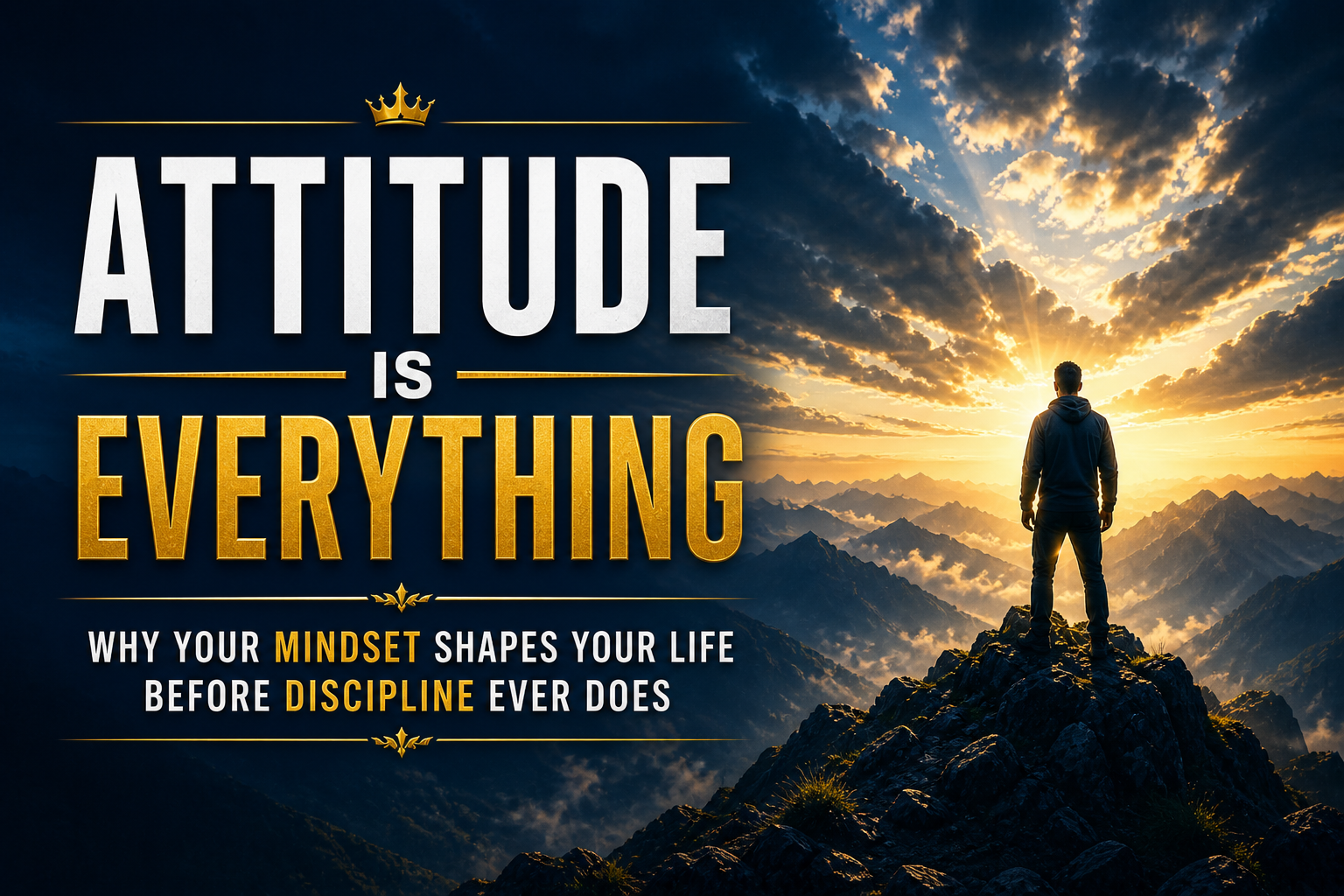
  • Attitude Is Everything: Why Your Mindset Shapes Your Life Before Discipline Ever Does

    Attitude Is Everything: Why Your Mindset Shapes Your Life Before Discipline Ever Does

    Two Salesmen. One Reality. Two Different Attitudes.

    There is an old story about a shoe company.

    The company sends two salesmen to Africa to see if there is a market for their shoes.

    The first salesman comes back and says:

    “There is no chance here.
    Nobody wears shoes.”

    The second salesman comes back and says:

    “There is a massive opportunity here.
    Nobody wears shoes yet.”

    Same place.
    Same facts.
    Same reality.

    But two completely different attitudes.

    One man saw a problem.
    The other saw a possibility.

    One saw the end.
    The other saw the beginning.

    And that is exactly what attitude does.

    It does not just influence what you think.
    It influences what you see.

    It shapes how you judge situations.
    How you respond to setbacks.
    How you handle responsibility.
    How you look at your future.
    And how much of your own potential you are willing to use.


    I Did Not Learn This Only From Books

    I did not learn this only from books.

    I learned it in my own life.

    When I was very young, around eighteen, nineteen, or in my early twenties, I had a terrible attitude.

    I was lazy.
    I was selfish.
    I looked for excuses.
    And most of the time, I found them.

    Nothing was really my fault.

    If something did not work, it was because of the circumstances.
    Because of other people.
    Because of the situation.
    Because of anything except me.


    How a Bad Attitude Is Formed

    I did not have strong role models at that time.
    So I adopted the attitude of the people around me.

    Not consciously.
    Not all at once.
    But slowly.

    That is how attitude often develops.

    Not through one big decision, but through what you hear every day.
    What you see every day.
    Who you spend time with.
    Which excuses become normal to you.
    Which limitations you start to accept.
    Which standards you never question.

    Back then, I did not understand that.

    I thought I was just the way I was.

    That was how I thought.
    That was how I acted.
    That was how I explained my life to myself.


    The Moment My Perspective Started to Change

    Until I came across a training program that changed the way I looked at everything.

    For the first time, I truly understood how deeply our attitude influences our lives.

    Not a little.

    Almost everything.

    How we see problems.
    How we recognize opportunities.
    How we respond to failure.
    How we deal with responsibility.
    How we look at ourselves.
    How we look at the future.

    Do we only see what is wrong?

    Or do we ask:

    What can I learn from this?
    What can I do with this?
    What opportunity is hidden here?
    What part of this is my responsibility?

    That shift changed something in me.

    Not because my life changed overnight.

    But because my perspective changed.


    Your Old Attitude Does Not Protect You

    I started reading books.
    I started listening to seminars.
    I absorbed audio programs, podcasts, and lessons from people who thought differently than I did.

    People who took responsibility.
    People who looked for possibilities.
    People who did not constantly explain why something could not work.

    They asked what needed to happen to make it work.

    And in the beginning, my attitude changed quickly.

    Because I realized something important:

    My old attitude had not protected me.

    It had kept me small.

    My excuses had not helped me.

    They had held me back.

    The way I thought was not simply “who I was.”

    It was something I had learned.

    And if I had learned it, I could also change it.


    When Your Attitude Changes, Your Decisions Change

    That was the beginning of a new direction for me.

    I did not become perfect.
    I did not suddenly become disciplined every single day.
    I did not turn into a completely different person overnight.

    But I started looking at myself differently.

    And that changed everything.

    Because when your attitude changes, your decisions change.

    You stop asking why something will not work.

    And you start asking what you can do.

    You stop seeing yourself only as a victim of circumstances.

    And you start taking responsibility.

    You stop seeing discipline as punishment.

    And you begin to understand that discipline grows out of your inner attitude.


    Discipline Is Not the Beginning

    That is why attitude matters so much.

    Discipline is not the beginning.

    Discipline is the result.

    The result of how you see yourself.
    The result of what you believe is possible.
    The result of what you accept from yourself.
    The result of the standards you choose to live by.

    A weak attitude makes every challenge heavier.

    A clear attitude does not make life easy.

    But it makes life clearer.

    You stop fighting against your own future.
    You stop protecting your excuses.
    You stop defending the version of yourself that is holding you back.

    And you begin to move differently.


    Attitude Is Not Positive Thinking

    That is why I wanted to write about attitude.

    Not as a motivational phrase.

    Not as a shallow “think positive” message.

    But as the foundation beneath discipline, confidence, responsibility, and growth.

    Because attitude is not about pretending everything is good.

    It is not about ignoring problems.

    It is not about lying to yourself.

    Attitude is the position you take when reality confronts you.

    Do you only see the obstacle?

    Or do you also see the possibility?

    Do you only see what is missing?

    Or do you see what can be built?

    Do you only focus on why it will be difficult?

    Or do you ask what is required to make it work?

    That difference matters.

    And sometimes, it changes everything.


    Why I Saw a Gap as an Opportunity

    When I later decided to write a book series about attitude, I was reminded of the story about the two shoe salesmen.

    I researched the market.

    I looked at which books existed.
    Which topics people searched for.
    Which words were common.

    And I noticed something interesting:

    There were not many books focused directly on attitude.

    Some people might look at that and say:

    “Then nobody is interested.”

    But I saw something else.

    I saw a gap.

    I saw an opportunity.

    Not because I wanted to fool myself.
    Not because I believed every risk is automatically a chance.

    But because I know this:

    The way you interpret a situation often decides what you do with it.

    And that is attitude.


    Same Reality. Different Conclusion.

    Two people can look at the same reality and walk away with two completely different conclusions.

    One sees a reason to stop.
    The other sees a reason to start.

    One sees proof that it will not work.
    The other sees proof that something is still possible.

    That is why attitude is everything.

    Because before your life changes, your perspective has to change.

    Before your discipline changes, your attitude has to change.

    Before your results change, your inner standard has to change.


    If Your Attitude Does Not Change, Nothing Changes

    And this is the sentence that stands behind everything I believe about this topic:

    If your attitude does not change, nothing changes.

    Not your decisions.
    Not your discipline.
    Not your results.
    Not your future.

    Because your attitude is not just one part of your life.

    It is the lens through which you see your life.

    And if that lens is weak, negative, passive, or full of excuses, then every opportunity will look smaller than it really is.

    But if your attitude becomes clearer, stronger, and more responsible, then the same reality begins to look different.

    Not easier.

    Different.

    You begin to see what you can control.
    You begin to recognize what you can improve.
    You begin to stop waiting for someone else to change your life for you.


    Real Self-Leadership Starts Here

    That is where real self-leadership begins.

    Not with motivation.

    Not with perfect circumstances.

    Not with a new plan.

    But with the decision to look at yourself and your life differently.

    Because in the end, it is not only what happens to you that matters.

    It is what you do with it.

    And what you do with it always begins with your attitude.

    If your attitude does not change, nothing changes.

    This section provides an overview of the blog, showcasing a variety of articles, insights, and resources to inform and inspire readers.

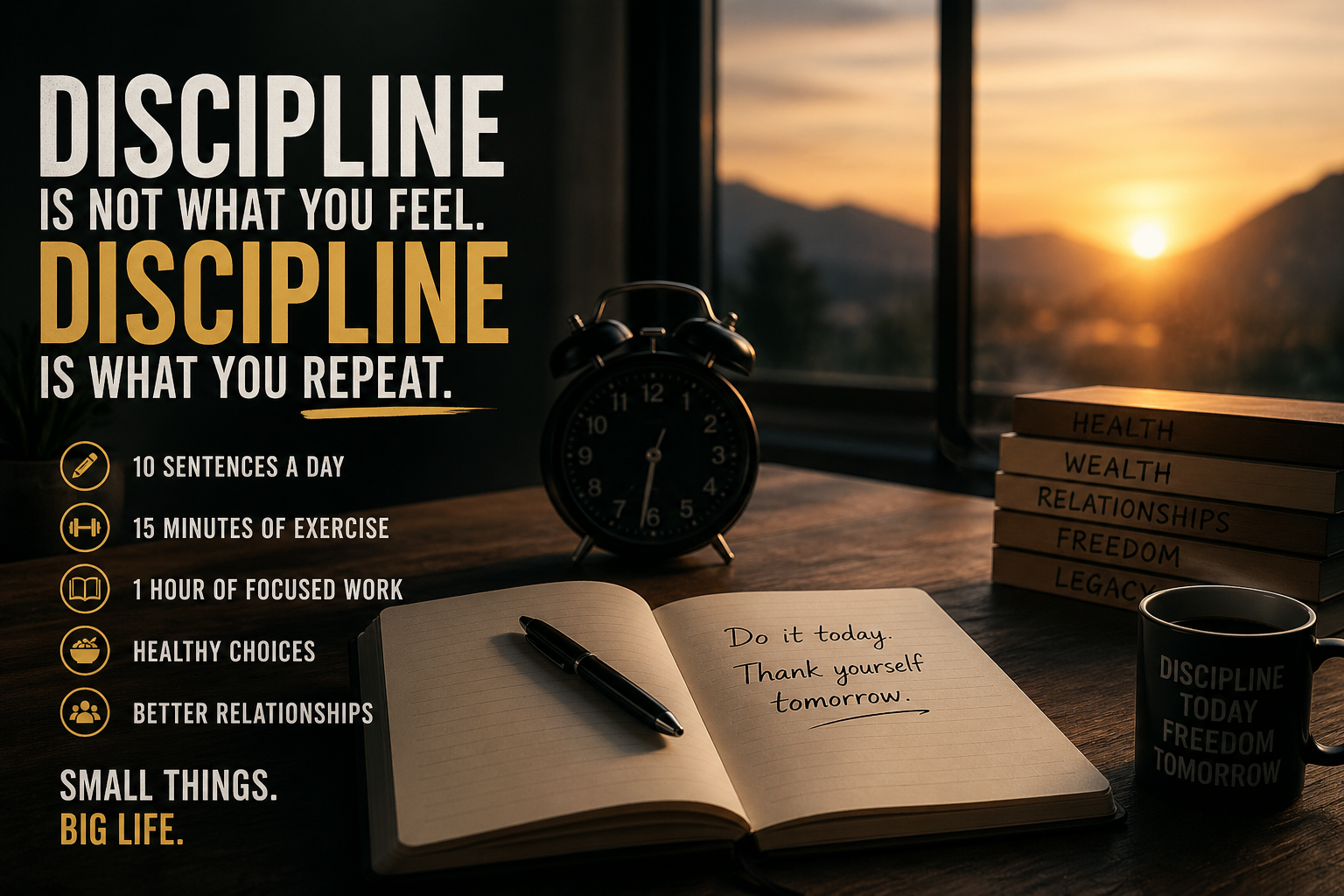
  • Discipline is not what you feel. Discipline is what you repeat.

    Discipline is not what you feel. Discipline is what you repeat.

    Blog

    Discipline Is Not a Feeling. Discipline Is a Daily Routine.

    Most people think discipline is about big decisions.

    They imagine extreme sacrifices, dramatic changes, early mornings, cold showers, strict schedules, and massive goals.

    But real discipline is usually much smaller than that.

    Discipline is not one heroic moment.

    Discipline is what you repeat.

    It is your habits.
    Your daily routines.
    Your small decisions.
    Your private standards.
    The things you do when nobody is watching.

    Because your life is not shaped by what you do once.

    It is shaped by what you do every day.

    There is a story often told about John Maxwell. He was once asked how he managed to write so many books. His answer was simple: he writes ten sentences every day.

    Not one chapter.
    Not one book.
    Not only when he feels inspired.
    Ten sentences.

    Every day.

    Even when he is tired.
    Even when he is busy.
    Even when it is Christmas.
    Even when he does not feel like it.

    That is discipline.

    Not because ten sentences sound impressive.

    But because ten sentences, repeated long enough, become pages.
    Pages become chapters.
    Chapters become books.
    Books become a body of work.

    That is the power of daily discipline.

    It does not look impressive in the moment.
    But it becomes powerful over time.

    The Small Things Decide the Big Things

    Most people overestimate what they can do in one day and underestimate what they can become through consistent action.

    They wait for the big breakthrough.

    The perfect moment.
    The perfect plan.
    The perfect motivation.
    The perfect opportunity.

    But discipline does not wait for perfect conditions.

    Discipline starts with what you can do today.

    Ten sentences.
    Fifteen minutes of exercise.
    One healthy meal.
    One page read.
    One message sent.
    One hour of focused work after your regular job.
    One honest conversation.
    One small step toward the business, body, relationship, or life you say you want.

    None of these things will change your life immediately.

    One workout will not transform your body.
    One salad will not make you healthy.
    One hour of work will not build your business.
    One conversation will not fix a relationship.
    One page will not make you wise.

    But repeated over months and years, these small actions become the foundation of your future.

    That is where most people lose.

    Not because they are not talented.
    Not because they do not have potential.
    Not because they do not have dreams.

    They lose because they keep looking for the big move while neglecting the small daily standards.

    Discipline is not about doing something huge once.

    Discipline is about doing the right things long enough for them to compound.

    Discipline Means Doing What You Do Not Yet Enjoy

    Another important part of discipline is this:

    Discipline means doing things you do not yet enjoy.

    Not forever.

    But at the beginning.

    Many of the things that create long-term success feel uncomfortable at first.

    Exercising feels uncomfortable when your body is not used to it.
    Writing feels uncomfortable when your thoughts are unclear.
    Speaking on camera feels uncomfortable when you are not used to being seen.
    Saving money feels uncomfortable when you are used to spending it.
    Building a business after work feels uncomfortable when your body wants the couch.
    Having honest conversations feels uncomfortable when you are used to avoiding conflict.

    But discomfort does not mean something is wrong.

    Sometimes discomfort is simply the feeling of growth.

    The reason many people avoid discipline is not because the action is impossible.

    It is because the action feels unfamiliar.

    And what feels unfamiliar often feels unpleasant.

    But here is the truth:

    What feels hard today can become normal tomorrow.

    The first workout feels heavy.
    After a few weeks, it becomes part of your rhythm.

    The first time you sit down to write, your mind may fight you.
    After enough repetition, writing becomes a routine.

    The first time you say no, you may feel guilty.
    After enough practice, you feel clear.

    The first time you work on your business after your job, it may feel exhausting.
    After enough time, it becomes your standard.

    This is how discipline works.

    You do not wait until you enjoy the action.

    You do the action until it becomes part of who you are.

    Your Brain Wants the Fast Reward

    One of the biggest reasons discipline is difficult is simple:

    Your brain is wired for immediate reward.

    It wants the fast pleasure.

    The pizza feels better today than the salad.
    The couch feels better today than fifteen minutes of exercise.
    Scrolling feels easier today than working on your business.
    Avoiding a difficult conversation feels safer today than facing the truth.
    Spending money feels better today than saving it.

    The problem is that the easiest choice today often becomes the hardest life tomorrow.

    Pizza every day does not destroy your health in one evening.
    But repeated for years, it changes your body.

    Skipping one workout does not ruin your fitness.
    But skipping for months becomes your identity.

    Scrolling for one hour after work does not destroy your future.
    But doing it every night steals the time that could have built something meaningful.

    Avoiding one honest conversation does not destroy a relationship.
    But avoiding every difficult conversation creates distance, resentment, and silence.

    Small choices do not feel dangerous because the consequences are delayed.

    That is why discipline matters.

    Discipline is the ability to act for the future even when the present offers an easier reward.

    It means you can see beyond today.

    You are not only asking, “What feels good right now?”

    You are asking, “What will this create if I repeat it for the next five years?”

    That question changes everything.

    Discipline Is About the Bigger Picture

    At its core, discipline means keeping the bigger picture in your mind.

    It means understanding that your actions today are building your life tomorrow.

    The salad today may not feel exciting.
    But repeated over months and years, it builds energy, health, confidence, and strength.

    The fifteen-minute workout today may not feel impressive.
    But repeated over time, it changes your body and your self-respect.

    The one hour of focused work after your job may not make you rich today.
    But repeated over years, it can build a business, a skill, a brand, or a new future.

    The time you invest in your relationships may not show immediate results.
    But repeated consistently, it builds trust, connection, and loyalty.

    Discipline is not about punishment.

    It is not about living a cold, joyless life.

    Discipline is about refusing to sacrifice your future for a short moment of comfort.

    It is about choosing what matters most over what feels easiest.

    Because your future does not arrive randomly.

    You build it through your repeated choices.

    Your Routine Is Your Real Standard

    Many people say they want a better life.

    But your routine tells the truth.

    Not your dreams.
    Not your words.
    Not your intentions.
    Your routine.

    If you say health matters, but your daily habits destroy your body, health is not yet your standard.

    If you say freedom matters, but you spend every evening escaping into distractions, freedom is not yet your standard.

    If you say your family matters, but you never give them your full attention, connection is not yet your standard.

    If you say your business matters, but you never protect time for it, growth is not yet your standard.

    This is not about shame.

    It is about honesty.

    Your current life is the result of repeated patterns.

    And your future life will be the result of new repeated patterns.

    That means you are not stuck.

    You can begin changing your future today.

    Not by changing everything at once.

    But by choosing one small standard and repeating it.

    Write ten sentences.
    Walk for fifteen minutes.
    Save ten euros.
    Read five pages.
    Do one focused hour.
    Prepare one healthy meal.
    Send one message that strengthens a relationship.
    Say no to one thing that weakens you.
    Say yes to one thing that grows you.

    Small things become serious when they become consistent.

    The Life You Want Is Built Before You See It

    The difficult part about discipline is that the reward is often invisible at the beginning.

    You do the work before you see the result.

    You train before you look fit.
    You save before you feel financially strong.
    You build before people notice.
    You write before anyone reads.
    You show up before the breakthrough appears.

    That is why many people quit too early.

    They do the right thing for a few days and think, “Nothing is changing.”

    But something is changing.

    Your identity is changing.

    Every disciplined action sends a message to yourself:

    “I am the kind of person who keeps promises to myself.”

    And that matters.

    Because before your life changes on the outside, your standards change on the inside.

    You start trusting yourself again.

    You start respecting yourself again.

    You stop depending on motivation.

    You stop waiting for the perfect mood.

    You become a person who acts with direction.

    That is real discipline.

    The Future Is Built in Ordinary Moments

    One day, the small things will no longer look small.

    The daily workout becomes a strong body.
    The healthy meals become energy and confidence.
    The saved money becomes stability and freedom.
    The focused work becomes a business.
    The honest conversations become stronger relationships.
    The ten sentences become a book.

    Nothing about it is magic.

    It is simply repetition.

    This is why discipline is one of the most powerful forces in a human life.

    Because discipline turns ordinary days into extraordinary results.

    Not immediately.

    But inevitably, when repeated long enough.

    So do not underestimate today.

    Today may feel normal.
    But today is where your future is being built.

    Not in the dream.
    Not in the plan.
    Not in the perfect moment.

    In the small decision you make next.

    Choose the action that serves your future.

    Choose the habit that strengthens your identity.

    Choose the routine that moves you closer to the life you actually want.

    Because discipline is not about being perfect.

    Discipline is about returning to your standard.

    Again.
    And again.
    And again.

    Until the life you once dreamed about becomes the life you actually live.

    This section provides an overview of the blog, showcasing a variety of articles, insights, and resources to inform and inspire readers.

  • Your Life Will Not Change Until You Do

    Your Life Will Not Change Until You Do

    Why real growth begins the moment you stop waiting for life to improve on its own

    Most people want a better life.

    They want better results, better relationships, better health, more peace, more money, more success. They hope that somehow things will improve. They wait for better circumstances, more luck, more support, or the right moment to finally move forward.

    But that is not how real change happens.

    Your life does not improve because you wish for it.
    It improves when you do.

    That is the truth many people avoid, because change is uncomfortable. It demands honesty. It demands responsibility. It demands that you look at yourself and admit that the way you are thinking, acting, or living may no longer be enough to create the future you want.

    And that is exactly why so many people stay stuck.

    They do not change because of habit.
    They do not change because of fear.
    They do not change because of pride.
    And sometimes, they do not change because they are too stubborn to admit that they must.

    But without change, life stays the same.

    If you keep thinking the same way, making the same excuses, tolerating the same patterns, and protecting the same comfort zone, then you will keep producing the same results. You cannot build a different future while refusing to become a different person.

    That is where real growth begins.


    Why Most People Resist Change

    People do not usually resist change because it is impossible.

    They resist it because it feels unfamiliar.

    Human beings like what they know. Even when their current life frustrates them, they often prefer familiar frustration over unfamiliar growth. They stay in routines that no longer serve them. They stay in environments that keep them small. They hold on to habits that quietly damage their confidence, their health, their relationships, or their future.

    Why?

    Because the known feels safe.

    Comfort can be dangerous in that way. It can make people accept a life that is far below what they are capable of building. It can make them believe that stability is more valuable than growth. It can keep them repeating the same year over and over again while telling themselves they are waiting for the right time.

    But the truth is simple:

    If nothing changes within you, very little will change around you.


    Change Does Not Begin Outside of You

    Many people are waiting for something external to save them.

    They wait for better opportunities.
    They wait for more motivation.
    They wait for someone to believe in them.
    They wait for life to become easier.

    But lasting change does not begin with better circumstances.

    It begins with a better decision.

    The most important shift a person can make is this: to understand that change begins with the self. Not with luck. Not with perfect timing. Not with other people. With you.

    That takes courage.

    It also takes wisdom.

    Because there is strength in saying, “I need to change.” Not because you are broken. Not because you are not enough. But because growth requires movement, and movement requires a willingness to evolve.

    The moment you stop expecting life to carry you and start choosing to develop yourself, your direction begins to change.

    Not overnight.
    Not magically.
    But powerfully.


    When You Change, Everything Around You Begins to Change

    This is what many people fail to understand:

    When you change internally, your external world begins to respond.

    You think differently.
    You make better decisions.
    You set stronger standards.
    You stop tolerating what weakens you.
    You become more intentional with your time, your energy, and your focus.

    And little by little, your life begins to reflect that shift.

    Your relationships improve because your standards improve.
    Your work improves because your discipline improves.
    Your confidence grows because your actions become more aligned.
    Your opportunities expand because you are no longer showing up as the same version of yourself.

    This is why personal change is never just personal.

    It touches everything.


    Real Change Is a Process, Not a Moment

    One of the biggest mistakes people make is expecting change to happen all at once.

    They want a breakthrough.
    They want instant transformation.
    They want one decision to erase years of patterns.

    But real change rarely works that way.

    Real change is a process.

    It happens through repeated choices. Through daily effort. Through the quiet decision to keep going even when the result is not visible yet. It happens when you keep showing up long enough for your thinking, habits, and identity to start shifting.

    Sometimes that process is slow.

    Sometimes it takes longer than you hoped.

    But that does not mean it is not working.

    The strongest transformations are often built in private, long before anyone else sees them.

    That is why mature people stop chasing quick fixes. They begin respecting the process. They understand that becoming stronger, wiser, calmer, more disciplined, or more capable may take years.

    And that is fine.

    Because a meaningful life is not built in one night.


    Successful People Learn to Welcome Change

    The people who grow the most are not the ones who avoid change.

    They are the ones who learn to work with it.

    They understand that change is part of life. Markets change. Relationships change. Seasons change. Demands change. The world does not stand still, and neither should we.

    Nature itself shows us this.

    Everything in nature adapts. Trees respond to the seasons. The weather shifts. Growth follows cycles. Nothing healthy stays frozen forever.

    So why would we expect to grow while refusing to adapt?

    The most successful people do not see change as a threat. They see it as a chance. A chance to improve. A chance to mature. A chance to become better prepared for what life is asking of them next.

    That is the mindset that separates those who grow from those who remain stuck.


    Targeted Change Is Better Than Passive Hope

    There is a big difference between hoping your life improves and actively changing the parts of yourself that must improve.

    Passive people wait.
    Intentional people move.

    Targeted change means looking honestly at your life and asking real questions:

    What habits are holding me back?
    What mindset keeps me small?
    Where am I avoiding responsibility?
    What do I need to change if I truly want different results?

    That is where progress becomes real.

    Because time alone does not change you. Struggle alone does not change you. Even desire alone does not change you.

    Intentional action does.

    When you choose change actively, you stop living by default. You stop drifting. You stop making your future dependent on chance. You begin shaping it with awareness.

    And that is where personal power returns.


    Change Gives You the Chance to Become Better

    We should not see change as loss.

    We should see it as opportunity.

    It is the opportunity to become better in every area of life.

    A better parent.
    A better partner.
    A better leader.
    A better employee.
    A better business owner.
    A better example.
    A better human being.

    Not perfect. Better.

    That is what makes change so valuable. It gives you a path forward. It gives you the chance to leave behind the habits, patterns, and limitations that no longer belong in your future.

    And the beautiful part is this:

    You do not need to become a completely different person tomorrow.

    You simply need to begin.


    Where Could Your Life Be in One Year? In Five?

    If you are willing to change actively and with purpose, you may be surprised by how much can happen in a year.

    A year from now, you could be stronger mentally.
    You could be healthier physically.
    You could be calmer emotionally.
    You could be more focused, more disciplined, more confident, and more self-respecting.

    And in five years, your life could look completely different.

    Not because you got lucky.
    Not because everything became easy.
    But because you stopped waiting and started changing.

    That is how real progress happens.

    One honest decision.
    One new standard.
    One better habit.
    One step at a time.


    Final Thought

    If you stay the same, much of your life will stay the same too.

    That may be hard to hear, but it is also empowering. Because it means your future is not fixed. It means you are not powerless. It means improvement is possible the moment you are willing to grow into it.

    Do not fear change.

    Use it.

    Use it to grow beyond your current limits. Use it to leave behind the patterns that no longer serve you. Use it to become the kind of person your future requires.

    Your life will not change until you do.

    But once you do, everything can begin to move.


    Call to Action

    Change does not begin with a perfect moment. It begins with a decision.

    If this message spoke to you, do not just read it and move on. Take a quiet moment today and ask yourself one honest question:

    What is one thing I know I need to change?

    Then start there.

    One decision made with courage can change the direction of an entire life.

    Blog

    This section provides an overview of the blog, showcasing a variety of articles, insights, and resources to inform and inspire readers.

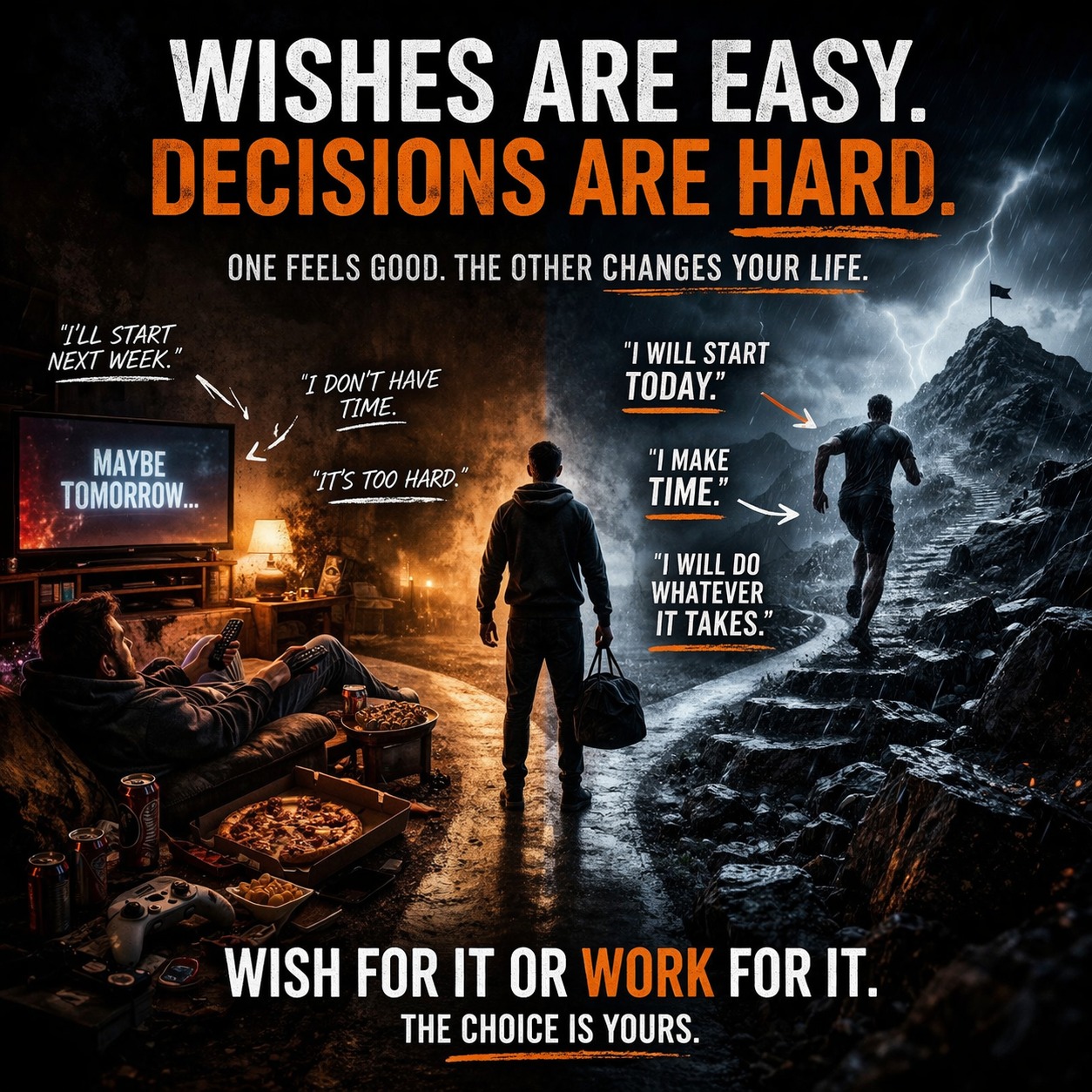
  • Wishes Sound Good. Decisions Cost Something.

    Wishes Sound Good. Decisions Cost Something.

    A lot of people say they have made a decision.

    They want to get in shape.
    Earn more money.
    Write a book.
    Build a business.
    Become more disciplined.
    Create a better life.

    But most people have not actually made a decision.

    They have only expressed a wish.

    And that difference matters more than most people realize.

    A wish costs nothing. A real decision does.

    Most “decisions” are just emotional statements

    It is easy to say you want something.

    It is easy to talk about change, think about change, plan for change, and imagine a better future. It is easy to feel motivated for a day and mistake that feeling for commitment.

    But motivation is not a decision.
    Talking is not a decision.
    Wanting something is not a decision.

    A decision is only real when it changes the way you live.

    That is the test.

    Not what you say.
    Not what you intend.
    Not what you post.
    What changes after the moment you claim you decided.

    Because if nothing changes, then nothing was decided.

    A real decision creates work

    The moment a decision is real, it creates responsibility.

    It changes your schedule.
    It changes your standards.
    It changes your use of time.
    It changes what you tolerate.
    It changes what you say yes to and what you finally say no to.

    That is why real decisions are rare.

    People love outcomes.
    They do not always love the cost attached to them.

    Everyone wants the result.
    Fewer people want the routine.
    Fewer people want the discipline.
    Fewer people want the sacrifice.

    But that is the truth: every real decision has a price.

    Not always money.
    But always something.

    Comfort.
    Convenience.
    Distraction.
    Sleep.
    Entertainment.
    Ease.
    Old habits.
    Short-term pleasure.

    If you truly decide to build something meaningful, something else has to move.

    Every real yes requires another no

    This is where many people get stuck.

    They want the new result without removing the old behavior.

    They want progress without rearranging their lives.
    They want growth without discomfort.
    They want a stronger future without giving up weak patterns.

    But every real decision is also a rejection.

    If you decide to train consistently, you are deciding against using that time somewhere else.
    If you decide to write a book, you are deciding against wasting your evenings.
    If you decide to build your business, you are deciding against endless comfort and passive living.
    If you decide to become disciplined, you are deciding against the version of you that always negotiates with excuses.

    That is what makes a decision real.

    It closes doors.

    Not because that is negative, but because focus always requires elimination.

    You cannot seriously commit to everything.
    And if you keep trying to keep everything, you will usually build nothing.

    “I don’t have time” is usually not the truth

    One of the most common excuses people use is this:

    “I don’t have time.”

    Almost everyone has said it.
    Almost everyone has believed it.
    But most of the time, it is not really true.

    The truth is usually harder and simpler:

    It is not that you do not have time.
    It is that you are not making space.

    Every person has 24 hours.

    Yes, people have different responsibilities.
    Yes, life is not equally easy for everyone.
    Yes, some people carry more weight than others.

    But even with all of that being true, one fact remains:

    The people who build strong bodies, strong businesses, strong minds, and strong lives do not have more hours than anyone else.

    They just treat time differently.

    They stop spending it casually.
    They stop leaking it everywhere.
    They stop handing it over to distraction, passivity, and low-value habits.

    They decide what matters.
    Then they build around it.

    That is why time is usually not the real problem.

    Lack of clarity is the problem.
    Lack of priority is the problem.
    Lack of follow-through is the problem.

    You know a decision is real when the excuses die

    A real decision removes your favorite escape routes.

    Once you truly decide, the conversation changes.

    You stop saying, “I’ll try.”
    You stop saying, “Let’s see.”
    You stop saying, “Maybe when things calm down.”
    You stop saying, “I just need more time.”

    Why?

    Because now you know what matters.

    And when you know what matters, you stop pretending that everything else is equally important.

    That does not mean the work becomes easy.
    It means the path becomes clear.

    You still have to do the work.
    You still have to show up tired sometimes.
    You still have to act when you do not feel like it.
    You still have to let certain things go.

    But now you are no longer hiding behind confusion.

    Now it is simple.

    You either do the work, or you do not.

    A wish wants the reward. A decision accepts the price.

    This is the core truth:

    A wish says, “I hope this happens.”

    A decision says, “I will organize my life around this.”

    That is the difference.

    A wish stays emotional.
    A decision becomes practical.

    A wish waits for the right mood.
    A decision acts regardless of mood.

    A wish talks about the future.
    A decision changes today.

    That is why so many people stay stuck for years.

    Not because they lack talent.
    Not because they lack potential.
    Not because they lack time.

    They stay stuck because they keep calling wishes decisions.

    And as long as you do that, you can keep feeling serious without ever becoming serious.

    If you want a different life, your calendar has to prove it

    A real decision can be seen.

    It shows up in your routine.
    It shows up in your calendar.
    It shows up in your habits.
    It shows up in what you cut out.
    It shows up in what you repeat.

    That is why your life does not change when your language changes.

    Your life changes when your structure changes.

    When your day starts reflecting what you say matters most, that is when progress becomes real.

    Until then, it is just talk.

    And that is not meant to discourage you.
    It is meant to wake you up.

    Because this is good news.

    If the problem were truly time, luck, or perfect conditions, you would be stuck waiting.

    But if the real problem is weak decision-making, then you can change that.

    Today.

    Final thought

    So ask yourself honestly:

    What in your life have you called a decision that is really just a wish?

    Where are you speaking with conviction but living without structure?

    Where do you keep saying you have no time, when the truth is that you have not made it important enough yet?

    Because in the end, this is how you know a decision is real:

    You do the work.
    You make the space.
    You accept the tradeoff.
    You stop hiding behind excuses.

    A real decision always costs something.

    But the life you want will cost something too.

    The question is not whether you will pay a price.

    The question is which price you are willing to pay.

    Blog

    This section provides an overview of the blog, showcasing a variety of articles, insights, and resources to inform and inspire readers.

  • How to Become a Social Magnet

    How to Become a Social Magnet

    Most people think being socially attractive is something you are either born with or not.

    That is not true.

    Being a social magnet is not about being the loudest person in the room.
    It is not about impressing people.
    And it is not about acting confident while feeling uncomfortable inside.

    A real social magnet makes people feel seen, relaxed, and valued.

    That can be learned.

    And in most cases, it starts with very simple things.

    1. Smile more often

    A genuine smile changes the energy immediately.

    It makes you look warmer.
    More open.
    More approachable.

    You do not need to force it.
    You do not need to grin all the time.

    But a small, natural smile makes a big difference.

    People feel safer around someone who looks relaxed.

    That is often the first step to better conversations.

    2. Say hello first

    Many people wait.

    They wait for the other person to start.
    They wait for the right moment.
    They wait until it feels easier.

    That usually creates distance.

    A social magnet does not always wait.
    They take small initiative.

    A simple “Hi” or “How are you?” is often enough.

    You do not need a perfect opener.
    You just need to open the door.

    Small courage creates connection.

    3. Show real interest

    This is one of the biggest differences.

    Many people want to be interesting.
    Very few people focus on being interested.

    But people remember how you made them feel.

    Ask simple questions.
    Listen to the answer.
    Stay present.

    Not to look good.
    Not to impress.
    But because you actually care.

    Real interest cannot be faked for long.
    People feel the difference.

    4. Listen to understand, not to reply

    A lot of conversations are not really conversations.

    One person talks.
    The other person waits for their turn.

    That is not connection.

    Good listening means you are fully there.
    You are not planning your next sentence while the other person is speaking.

    You are paying attention.

    You notice their words.
    Their tone.
    Their energy.

    And sometimes the best response is not a long answer.

    Sometimes it is simply:

    “That makes sense.”
    “I understand.”
    “Tell me more.”

    People open up when they feel heard.

    5. Use open body language

    Your body speaks before you do.

    If your posture is closed, tense, or defensive, people feel it immediately.

    Simple changes help:

    Stand upright.
    Relax your shoulders.
    Keep your arms open.
    Make calm eye contact.
    Face people when they speak.

    You do not need perfect body language.
    You just need to look present and open.

    That alone makes you more attractive socially.

    6. Make people feel important

    This does not mean flattering people.

    It means treating them like they matter.

    Remember small details.
    Use their name naturally.
    Pay attention when they speak.
    Do not constantly check your phone.
    Do not look around for someone “more important.”

    Presence is rare.

    And because it is rare, it is powerful.

    7. Stop trying so hard to impress

    This is where many people lose their natural charm.

    They try too hard to sound smart.
    Funny.
    Successful.
    Different.

    But real presence is more attractive than performance.

    You do not need to win people over with words.

    Be calm.
    Be real.
    Be interested.

    That creates much stronger energy than trying to prove yourself.

    8. Bring good energy into the room

    Energy is contagious.

    If you are negative, cold, or tense, people feel it.

    If you are calm, warm, and grounded, people feel that too.

    This does not mean pretending to be happy all the time.

    It means taking responsibility for the energy you bring.

    Sometimes being a social magnet is simply about being the person who makes things lighter, easier, and more comfortable.

    9. Practice in small moments

    You do not become socially stronger overnight.

    You build it in daily life.

    Smile at people.
    Say hello first.
    Ask one real question.
    Listen a little better.
    Hold eye contact a little longer.
    Stay relaxed in simple conversations.

    That is how social confidence grows.

    Not through theory.
    Through repetition.

    Final thought

    Being a social magnet is not about becoming someone else.

    It is about becoming more open, more present, and more genuinely interested in people.

    The good news is this:

    You do not need extreme charisma.
    You do not need perfect social skills.
    You do not need to be the center of attention.

    You just need to make people feel comfortable around you.

    That is where real connection begins.

    And in the long run, that is what makes people remember you.

    Blog

    This section provides an overview of the blog, showcasing a variety of articles, insights, and resources to inform and inspire readers.

  • Why Routines Are the Foundation of Success in Every Area of Life

    Why Routines Are the Foundation of Success in Every Area of Life

    Most people want results.

    Better health.
    Stronger relationships.
    More money.
    A successful career.

    But very few people focus on the one thing that actually creates those results:

    Routines.

    Because success is not built in big moments.
    It is built in what you do every day.


    Why Routines Matter More Than Motivation

    Motivation is unreliable.

    Some days you feel driven.
    Most days you don’t.

    If your progress depends on motivation, you will always move forward… and then fall back again.

    Routines solve this problem.

    They remove the need to decide every day.
    They reduce resistance.
    They turn action into something automatic.

    Instead of asking:
    “Do I feel like it today?”

    You follow a structure.

    And that changes everything.


    Success Is Always Routine-Based

    Look at any area of life:

    Health

    You don’t get fit by working out once.
    You get fit by training consistently.

    Relationships

    You don’t build strong connections with one conversation.
    You build them through regular attention, presence, and communication.

    Finances

    You don’t create wealth through one big decision.
    You build it through consistent habits — saving, investing, managing.

    Career

    You don’t grow by occasional effort.
    You grow by showing up, learning, improving, and executing daily.


    Without Routines, Nothing Sticks

    Without routines:

    • you start… and stop
    • you try… and fall back
    • you make progress… and lose it again

    That’s why most people feel stuck.

    Not because they don’t know what to do.
    But because they don’t do it consistently.


    What Good Routines Actually Do

    Strong routines create:

    • structure → you know what to do
    • clarity → you focus on what matters
    • consistency → you keep going
    • momentum → progress builds naturally

    And over time, something important happens:

    👉 The effort becomes part of who you are.

    You stop forcing yourself.
    You start operating on a higher standard.


    How to Start Building Better Routines

    You don’t need a perfect system.

    You need a simple one.

    Start here:

    1. Focus on one area

    Don’t try to fix everything at once.
    Pick one area that matters most right now.


    2. Define one simple routine

    Make it small and clear.

    Not:
    “I will change my life.”

    But:
    “I train 3 times per week.”
    “I read 10 minutes every day.”
    “I plan my day every morning.”


    3. Make it non-negotiable

    Remove the decision.

    It’s not:
    “I’ll do it if I feel like it.”

    It’s:
    “I do this. No matter what.”


    4. Stay consistent, not perfect

    You don’t need perfection.

    You need repetition.

    Miss a day?
    Continue.

    That’s how routines become stable.


    Final Thought

    Success is not complicated.

    But it is structured.

    If you want real results in your health, your relationships, your finances, or your career…

    👉 build better routines.

    Because in the end:Your life is not shaped by what you want.
    It is shaped by what you repeat.

    Blog

    This section provides an overview of the blog, showcasing a variety of articles, insights, and resources to inform and inspire readers.