Discipline — Why Commitment Beats Motivation (And How to Stay Consistent Every Day)
Most people do not fail because they lack motivation.
They fail because they lack commitment.
That truth may sound hard, but it explains why so many people stay stuck for years.
They wait to feel motivated.
They wait to feel ready.
They wait for the perfect time.
And that is exactly why nothing changes.
Motivation comes and goes
Motivation is unstable.
Some days you feel focused, energized, and ready to take action.
Other days you feel tired, distracted, and completely off.
If your progress depends on your emotions, your results will always be inconsistent.
That is why motivation is never enough.
Commitment is stronger than emotion
Commitment means showing up even when you do not feel like it.
It means continuing after the excitement is gone.
It means staying loyal to a decision you made.
Motivation says:
“I’ll do it when I feel ready.”
Commitment says:
“I decided. So I follow through.”
That is where real growth begins.
But commitment becomes easier when it means something
Here is what many people miss:
Commitment becomes much easier when you are working toward something that actually matters to you.
When you are building something you care about,
something that excites you,
something that feels meaningful,
something that connects to the life you truly want—
then discipline feels different.
It becomes personal.
It is no longer just effort.
It becomes an expression of who you are and what matters to you.
That does not mean every day feels easy.
But it gives your actions depth.
And depth creates strength.
Meaning creates endurance
You can force yourself for a while.
But long-term consistency is rarely built on pressure alone.
It is built on meaning.
When your goal feels empty, every step feels heavy.
When your goal feels meaningful, even difficult days become easier to carry.
That is why purpose matters.
Not because it replaces discipline.
But because it makes discipline easier to sustain.
If your work reflects something real to you,
something that energizes you,
something you actually believe in—
you are far more likely to stay committed when things get hard.
Ask yourself a better question
Instead of asking:
“Why am I not disciplined enough?”
Ask:
“Am I committed to something that truly matters to me?”
Because sometimes the issue is not your discipline.
Sometimes the issue is that your goal has no real weight in your life.
No real emotional connection.
No real meaning.
And without meaning, commitment becomes much harder.
The real formula
A strong life is built on both:
- meaningful direction
- committed action
Purpose gives you energy.
Commitment gives you consistency.
You need both.
Final thought
Commitment is what carries you when motivation disappears.
But commitment becomes much stronger when your actions are tied to something real—
something you care about,
something that excites you,
something that gives your life meaning.
That is when you stop chasing random goals
and start building a life that actually matters.
Because the strongest commitment is not forced.
It grows out of something real.
Want to go deeper?
I created this because I know how easy it is to rely on motivation—
and how often that falls apart.
If you want a simple, practical system to stay consistent and build real discipline,
check out my book on Amazon and the audiobook on Spotify.
It is designed to help you follow through—especially on the days you do not feel like it.
Blog Article: Values — The Foundation of Character, Clarity, and Real Success
A lot of people talk about success.
About goals.
About discipline.
About confidence.
But very few stop and ask themselves one important question:
What is my life actually built on?
Because real character is not revealed when life is easy.
It is revealed when things become uncomfortable.
When honesty costs you something.
When saying no creates tension.
When you have to choose between short-term gain and your deeper values.
That is where true character begins.
What values actually matter to you?
Most people do not live from clear values.
They react.
They adapt.
They make decisions based on fear, comfort, pressure, or the need to be liked.
But if you are not clear on what truly matters to you, you will always become unstable in the moments that matter most.
So ask yourself honestly:
- What values actually matter to me?
- Why those values?
- Do I really live them in everyday life?
- Or do I only talk about them when it is easy?
- Do I make decisions based on my values even when it might cost me something?
These are not small questions.
These are foundation questions.
Values are not proven by words. They are proven by decisions.
Anyone can say honesty matters.
Anyone can claim to value loyalty, discipline, courage, or respect.
But values are not shown in what you say.
They are shown in what you do under pressure.
If respect matters to you, how do you speak when you are frustrated?
If responsibility matters to you, do you own your mistakes or look for excuses?
If courage matters to you, do you act when fear is present?
Your values show up in your daily choices.
Not in your image.
Not in your intentions.
Not in the version of yourself you like to imagine.
Real character is always built on values
Character is not image.
It is not volume.
It is not perfection.
Character is stability.
It is having something inside you strong enough to guide you when emotion, pressure, temptation, or uncertainty show up.
People without clear values often live in reaction mode.
They are led by opinions.
By trends.
By approval.
By comfort.
By the fear of disappointing others.
People with clear values live with more clarity.
Not because life becomes easier.
But because decisions become cleaner.
Real success cannot exist without values
Some people win in the short term and lose themselves in the long term.
They may look successful from the outside, but there is no real foundation underneath it.
Real success is not only about what you achieve.
It is also about how you achieve it.
And whether you can still respect yourself when no one is watching.
Success without values is unstable.
Success built on values is strong.
When your life is built on honesty, discipline, responsibility, respect, courage, and integrity, something deeper begins to grow:
- trust
- inner strength
- clarity
- self-respect
That is the kind of success that lasts.
Do you actually live your values?
It is not enough to admire values.
You have to live them.
That means:
- staying honest when a lie would be easier
- setting boundaries when self-respect requires it
- taking responsibility instead of making excuses
- standing by your principles even when others do not understand
- making decisions that match your character, not just your short-term advantage
That is where real strength begins.
Take a moment today
Sit down and write out five values that truly matter to you.
Not the ones that sound impressive.
The ones you actually want your life to stand on.
Then ask yourself for each one:
- What does this value mean to me in real life?
- Where am I already living it?
- Where am I betraying it?
- What decision would I need to make to live it more fully?
Because in the end, your life always reflects your decisions.
And your decisions always reflect your foundation.
Final Thought
Values are not a side topic.
They are the foundation.
The foundation of your character.
The foundation of your decisions.
The foundation of your success.
When you know your values, you live with more clarity.
When you live your values, you become stronger.
And when you build on values, you create a kind of success that is not just visible — but real.
The question is not only which values matter to you.
The real question is: do you still live them when it costs you something?
Setting Boundaries Is Not Cold. It’s SELF-RESPECT.
A lot of people struggle with boundaries.
Not because they are weak.
But because they were taught to adjust.
They say yes when they mean no.
They stay available when they need rest.
They help when they already feel drained.
And over time, they start wondering why they feel irritated, exhausted, or disconnected from themselves.
The answer is often simple:
When you never set boundaries, you slowly ABANDON YOURSELF.
Why boundaries matter
Boundaries are not about pushing people away.
They are about being clear about what is okay for you and what is not.
A healthy boundary says:
THIS WORKS FOR ME.
THIS DOES NOT.
THIS IS WHERE I STOP.
THIS IS WHAT I NEED.
Many people think boundaries are harsh.
They think saying no makes them selfish.
They think protecting their time or energy will disappoint others.
But the truth is this:
People who never set boundaries do not only lose energy.
They often lose SELF-RESPECT too.
Not because they are doing something wrong on purpose.
But because every time you ignore your own limit, you teach yourself that your needs come last.
And eventually, that becomes your pattern.
Why so many people fear setting boundaries
Setting boundaries sounds simple.
But for many people, it feels deeply uncomfortable.
Why?
Because poor boundaries usually come from deeper patterns.
1. Fear of rejection
Many people say yes because they do not want to upset anyone.
They do not want to seem difficult.
They do not want to lose approval.
So they stay agreeable.
Even when it costs them peace.
2. Guilt
Some people feel guilty the moment they say no.
Even when the no is healthy.
Even when they are already overwhelmed.
3. Old conditioning
If you learned early in life to be easy, helpful, quiet, or low-maintenance, boundaries may feel unnatural now.
You may still carry the belief that being good means making yourself smaller.
4. Confusing love with self-sacrifice
Some people believe being a caring person means always being there.
Always giving.
Always making room.
But being loving does not mean ABANDONING YOURSELF.
What happens when you do not set boundaries
Living without boundaries comes at a price.
It may look like this:
- You feel drained for no clear reason.
- You become resentful.
- You say yes too quickly and regret it later.
- You feel emotionally tired.
- You start feeling overlooked, used, or invisible.
- Your self-worth begins to drop.
And the problem is that many people do not realize what is really happening.
Sometimes what they really need is more SELF-PROTECTION.
Boundaries are self-respect in action
A boundary is not an attack.
It is not drama.
It is not punishment.
A healthy boundary is calm.
Clear.
Simple.
It can sound like this:
“Thanks, but that does not work for me right now.”
“I can’t take that on today.”
“I need some time for myself.”
“That is not something I can commit to at the moment.”
You do not need a long explanation every time.
You do not need to justify every limit.
The people who respect you do not need a performance.
They need CLARITY.
Every no can be a yes to yourself
This is the part many people miss.
When you say no to what drains you,
you say yes to your energy.
When you say no to what crosses your limit,
you say yes to your self-respect.
When you stop overcommitting,
you make space for what actually matters.
That is why boundaries are not only about protection.
They are also about DIRECTION.
How to start setting better boundaries
Boundaries are not a personality trait.
They are a skill.
And like any skill, they get stronger with practice.
1. Notice sooner when something feels off
A lot of people only speak up once they are already frustrated.
Try to catch the discomfort earlier.
2. Stop answering too quickly
You do not need to respond immediately to every request.
Simple phrases like these create space:
“Let me think about it.”
“I’ll get back to you.”
“I need to check my schedule first.”
Space helps you answer from clarity instead of pressure.
3. Use clear and simple language
You do not need a long excuse.
A respectful no is enough.
4. Let the discomfort be there
If boundary-setting is new for you, it may feel uncomfortable at first.
That does not mean it is wrong.
Sometimes the discomfort is not a sign that you are doing harm.
It is a sign that you are breaking an old pattern.
5. Start small
You do not need to change everything in one week.
Start with small moments:
- Decline one thing you do not want to do.
- Take longer before saying yes.
- Protect one hour for yourself.
- Be honest when you need rest.
Small boundaries build strong SELF-TRUST.
Boundaries do not ruin relationships. They reveal them.
A lot of people are afraid that boundaries will cost them connection.
But healthy boundaries do not destroy real relationships.
They strengthen them.
Because real relationships can handle honesty.
And if someone only likes you when you overgive, overadapt, or overextend yourself, that is not real closeness.
That is dependency on your lack of limits.
Boundaries do not only protect you.
They also show you what is healthy and what is not.
Final thought
Setting boundaries does not mean becoming cold.
It means you stop leaving yourself behind.
It means your time matters.
Your energy matters.
Your peace matters.
Your needs matter too.
At the end of the day, a boundary is just a clear message:
I MATTER TOO.
And that is not selfish.
That is SELF-RESPECT.
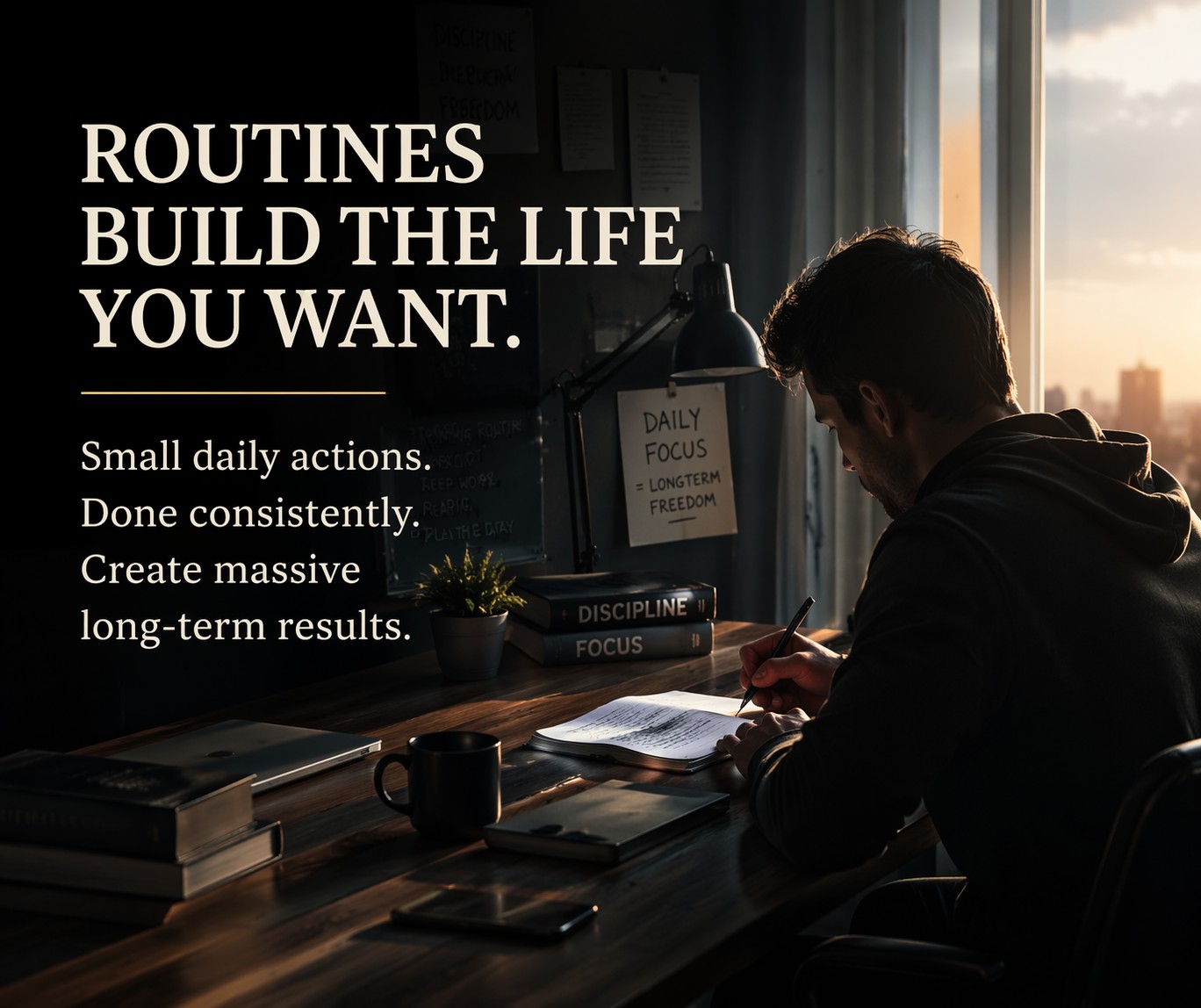
Why Routines Are the Foundation of Success in Every Area of Life
Most people want results.
Better health.
Stronger relationships.
More money.
A successful career.
But very few people focus on the one thing that actually creates those results:
Routines.
Because success is not built in big moments.
It is built in what you do every day.
Why Routines Matter More Than Motivation
Motivation is unreliable.
Some days you feel driven.
Most days you don’t.
If your progress depends on motivation, you will always move forward… and then fall back again.
Routines solve this problem.
They remove the need to decide every day.
They reduce resistance.
They turn action into something automatic.
Instead of asking:
“Do I feel like it today?”
You follow a structure.
And that changes everything.
Success Is Always Routine-Based
Look at any area of life:
Health
You don’t get fit by working out once.
You get fit by training consistently.
Relationships
You don’t build strong connections with one conversation.
You build them through regular attention, presence, and communication.
Finances
You don’t create wealth through one big decision.
You build it through consistent habits — saving, investing, managing.
Career
You don’t grow by occasional effort.
You grow by showing up, learning, improving, and executing daily.
Without Routines, Nothing Sticks
Without routines:
- you start… and stop
- you try… and fall back
- you make progress… and lose it again
That’s why most people feel stuck.
Not because they don’t know what to do.
But because they don’t do it consistently.
What Good Routines Actually Do
Strong routines create:
- structure → you know what to do
- clarity → you focus on what matters
- consistency → you keep going
- momentum → progress builds naturally
And over time, something important happens:
👉 The effort becomes part of who you are.
You stop forcing yourself.
You start operating on a higher standard.
How to Start Building Better Routines
You don’t need a perfect system.
You need a simple one.
Start here:
1. Focus on one area
Don’t try to fix everything at once.
Pick one area that matters most right now.
2. Define one simple routine
Make it small and clear.
Not:
“I will change my life.”
But:
“I train 3 times per week.”
“I read 10 minutes every day.”
“I plan my day every morning.”
3. Make it non-negotiable
Remove the decision.
It’s not:
“I’ll do it if I feel like it.”
It’s:
“I do this. No matter what.”
4. Stay consistent, not perfect
You don’t need perfection.
You need repetition.
Miss a day?
Continue.
That’s how routines become stable.
Final Thought
Success is not complicated.
But it is structured.
If you want real results in your health, your relationships, your finances, or your career…
👉 build better routines.
Because in the end:
Your life is not shaped by what you want.
It is shaped by what you repeat.
How to Become a Social Magnet
Most people think being socially attractive is something you are either born with or not.
That is not true.
Being a social magnet is not about being the loudest person in the room.
It is not about impressing people.
And it is not about acting confident while feeling uncomfortable inside.
A real social magnet makes people feel seen, relaxed, and valued.
That can be learned.
And in most cases, it starts with very simple things.
1. Smile more often
A genuine smile changes the energy immediately.
It makes you look warmer.
More open.
More approachable.
You do not need to force it.
You do not need to grin all the time.
But a small, natural smile makes a big difference.
People feel safer around someone who looks relaxed.
That is often the first step to better conversations.
2. Say hello first
Many people wait.
They wait for the other person to start.
They wait for the right moment.
They wait until it feels easier.
That usually creates distance.
A social magnet does not always wait.
They take small initiative.
A simple “Hi” or “How are you?” is often enough.
You do not need a perfect opener.
You just need to open the door.
Small courage creates connection.
3. Show real interest
This is one of the biggest differences.
Many people want to be interesting.
Very few people focus on being interested.
But people remember how you made them feel.
Ask simple questions.
Listen to the answer.
Stay present.
Not to look good.
Not to impress.
But because you actually care.
Real interest cannot be faked for long.
People feel the difference.
4. Listen to understand, not to reply
A lot of conversations are not really conversations.
One person talks.
The other person waits for their turn.
That is not connection.
Good listening means you are fully there.
You are not planning your next sentence while the other person is speaking.
You are paying attention.
You notice their words.
Their tone.
Their energy.
And sometimes the best response is not a long answer.
Sometimes it is simply:
“That makes sense.”
“I understand.”
“Tell me more.”
People open up when they feel heard.
5. Use open body language
Your body speaks before you do.
If your posture is closed, tense, or defensive, people feel it immediately.
Simple changes help:
Stand upright.
Relax your shoulders.
Keep your arms open.
Make calm eye contact.
Face people when they speak.
You do not need perfect body language.
You just need to look present and open.
That alone makes you more attractive socially.
6. Make people feel important
This does not mean flattering people.
It means treating them like they matter.
Remember small details.
Use their name naturally.
Pay attention when they speak.
Do not constantly check your phone.
Do not look around for someone “more important.”
Presence is rare.
And because it is rare, it is powerful.
7. Stop trying so hard to impress
This is where many people lose their natural charm.
They try too hard to sound smart.
Funny.
Successful.
Different.
But real presence is more attractive than performance.
You do not need to win people over with words.
Be calm.
Be real.
Be interested.
That creates much stronger energy than trying to prove yourself.
8. Bring good energy into the room
Energy is contagious.
If you are negative, cold, or tense, people feel it.
If you are calm, warm, and grounded, people feel that too.
This does not mean pretending to be happy all the time.
It means taking responsibility for the energy you bring.
Sometimes being a social magnet is simply about being the person who makes things lighter, easier, and more comfortable.
9. Practice in small moments
You do not become socially stronger overnight.
You build it in daily life.
Smile at people.
Say hello first.
Ask one real question.
Listen a little better.
Hold eye contact a little longer.
Stay relaxed in simple conversations.
That is how social confidence grows.
Not through theory.
Through repetition.
Final thought
Being a social magnet is not about becoming someone else.
It is about becoming more open, more present, and more genuinely interested in people.
The good news is this:
You do not need extreme charisma.
You do not need perfect social skills.
You do not need to be the center of attention.
You just need to make people feel comfortable around you.
That is where real connection begins.
And in the long run, that is what makes people remember you.
Wishes Sound Good. Decisions Cost Something.
A lot of people say they have made a decision.
They want to get in shape.
Earn more money.
Write a book.
Build a business.
Become more disciplined.
Create a better life.
But most people have not actually made a decision.
They have only expressed a wish.
And that difference matters more than most people realize.
A wish costs nothing. A real decision does.
Most “decisions” are just emotional statements
It is easy to say you want something.
It is easy to talk about change, think about change, plan for change, and imagine a better future. It is easy to feel motivated for a day and mistake that feeling for commitment.
But motivation is not a decision.
Talking is not a decision.
Wanting something is not a decision.
A decision is only real when it changes the way you live.
That is the test.
Not what you say.
Not what you intend.
Not what you post.
What changes after the moment you claim you decided.
Because if nothing changes, then nothing was decided.
A real decision creates work
The moment a decision is real, it creates responsibility.
It changes your schedule.
It changes your standards.
It changes your use of time.
It changes what you tolerate.
It changes what you say yes to and what you finally say no to.
That is why real decisions are rare.
People love outcomes.
They do not always love the cost attached to them.
Everyone wants the result.
Fewer people want the routine.
Fewer people want the discipline.
Fewer people want the sacrifice.
But that is the truth: every real decision has a price.
Not always money.
But always something.
Comfort.
Convenience.
Distraction.
Sleep.
Entertainment.
Ease.
Old habits.
Short-term pleasure.
If you truly decide to build something meaningful, something else has to move.
Every real yes requires another no
This is where many people get stuck.
They want the new result without removing the old behavior.
They want progress without rearranging their lives.
They want growth without discomfort.
They want a stronger future without giving up weak patterns.
But every real decision is also a rejection.
If you decide to train consistently, you are deciding against using that time somewhere else.
If you decide to write a book, you are deciding against wasting your evenings.
If you decide to build your business, you are deciding against endless comfort and passive living.
If you decide to become disciplined, you are deciding against the version of you that always negotiates with excuses.
That is what makes a decision real.
It closes doors.
Not because that is negative, but because focus always requires elimination.
You cannot seriously commit to everything.
And if you keep trying to keep everything, you will usually build nothing.
“I don’t have time” is usually not the truth
One of the most common excuses people use is this:
“I don’t have time.”
Almost everyone has said it.
Almost everyone has believed it.
But most of the time, it is not really true.
The truth is usually harder and simpler:
It is not that you do not have time.
It is that you are not making space.
Every person has 24 hours.
Yes, people have different responsibilities.
Yes, life is not equally easy for everyone.
Yes, some people carry more weight than others.
But even with all of that being true, one fact remains:
The people who build strong bodies, strong businesses, strong minds, and strong lives do not have more hours than anyone else.
They just treat time differently.
They stop spending it casually.
They stop leaking it everywhere.
They stop handing it over to distraction, passivity, and low-value habits.
They decide what matters.
Then they build around it.
That is why time is usually not the real problem.
Lack of clarity is the problem.
Lack of priority is the problem.
Lack of follow-through is the problem.
You know a decision is real when the excuses die
A real decision removes your favorite escape routes.
Once you truly decide, the conversation changes.
You stop saying, “I’ll try.”
You stop saying, “Let’s see.”
You stop saying, “Maybe when things calm down.”
You stop saying, “I just need more time.”
Why?
Because now you know what matters.
And when you know what matters, you stop pretending that everything else is equally important.
That does not mean the work becomes easy.
It means the path becomes clear.
You still have to do the work.
You still have to show up tired sometimes.
You still have to act when you do not feel like it.
You still have to let certain things go.
But now you are no longer hiding behind confusion.
Now it is simple.
You either do the work, or you do not.
A wish wants the reward. A decision accepts the price.
This is the core truth:
A wish says, “I hope this happens.”
A decision says, “I will organize my life around this.”
That is the difference.
A wish stays emotional.
A decision becomes practical.
A wish waits for the right mood.
A decision acts regardless of mood.
A wish talks about the future.
A decision changes today.
That is why so many people stay stuck for years.
Not because they lack talent.
Not because they lack potential.
Not because they lack time.
They stay stuck because they keep calling wishes decisions.
And as long as you do that, you can keep feeling serious without ever becoming serious.
If you want a different life, your calendar has to prove it
A real decision can be seen.
It shows up in your routine.
It shows up in your calendar.
It shows up in your habits.
It shows up in what you cut out.
It shows up in what you repeat.
That is why your life does not change when your language changes.
Your life changes when your structure changes.
When your day starts reflecting what you say matters most, that is when progress becomes real.
Until then, it is just talk.
And that is not meant to discourage you.
It is meant to wake you up.
Because this is good news.
If the problem were truly time, luck, or perfect conditions, you would be stuck waiting.
But if the real problem is weak decision-making, then you can change that.
Today.
Final thought
So ask yourself honestly:
What in your life have you called a decision that is really just a wish?
Where are you speaking with conviction but living without structure?
Where do you keep saying you have no time, when the truth is that you have not made it important enough yet?
Because in the end, this is how you know a decision is real:
You do the work.
You make the space.
You accept the tradeoff.
You stop hiding behind excuses.
A real decision always costs something.
But the life you want will cost something too.
The question is not whether you will pay a price.
The question is which price you are willing to pay.